


By Clint L. Sanchez
Large events tend to get accessibility roughly right, because scale forces the question. When you are staging forty portable restrooms across a festival ground, somebody on the planning side does the percentage math, and at least a couple of accessible units end up on the order.
The events that get it wrong are the small ones. A church picnic. A company field day. A backyard wedding for eighty people. The kind of event where somebody looks at the guest count, decides two units will do, and books two standard units.
That decision is usually the non-compliant one, and the reason is a piece of the standard almost nobody outside the industry knows.
One unit means the accessible one
The 2010 ADA Standards for Accessible Design handle clustered single-user portable units with a percentage. Where such units are grouped at one location, no more than 5 percent of the units at each cluster are required to comply with the accessibility standards. It is a ceiling on the requirement rather than a quota, and at any real festival scale it works out to a small number of accessible units in each bank.
But the guidance is explicit about the floor. Where only one portable toilet unit is provided, it has to be the accessible one.
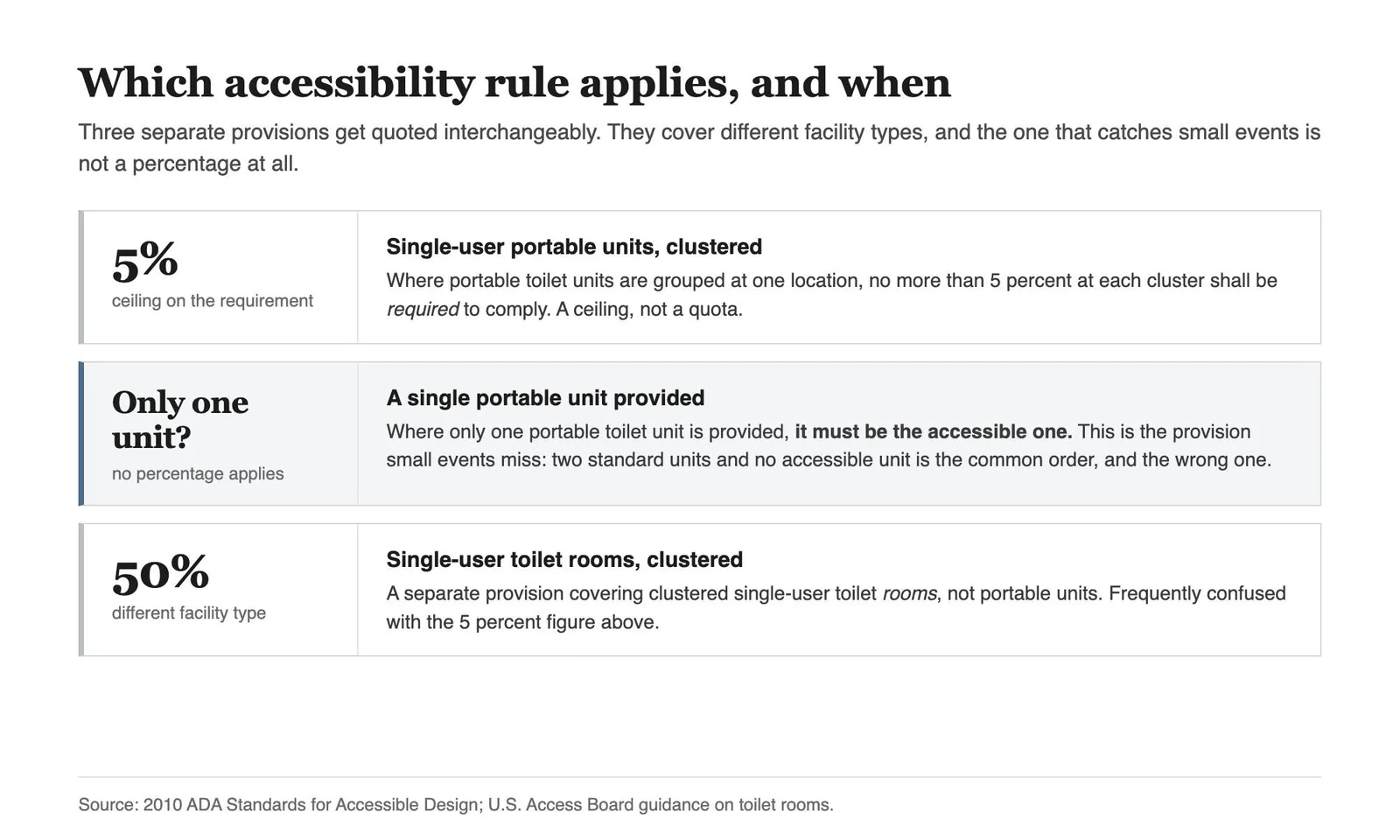

Read that against how small events actually order. Two units, one marked for men and one for women, neither accessible, is a common arrangement and a poor one. So is a single unit at a job site trailer or a one-afternoon community event. The percentage never enters into it, because there is no meaningful cluster to take a percentage of.
There is also a distinction worth keeping straight, because the two numbers get mixed up constantly. The 5 percent provision covers portable units. A separate provision, dealing with clustered single-user toilet rooms, uses 50 percent. Those are different facility types under the standard, and quoting the wrong one at a planner is a fast way to lose credibility.
Why the small event is the harder problem
The instinct is to treat accessibility as a big-event concern, which gets it backwards.
At a festival, an accessible unit sits in a bank with a dozen others. A guest who needs it walks the same direction as everyone else and uses the one on the end. The accommodation is invisible, which is what a good accommodation looks like.
At an eighty-person backyard wedding with two units, there is no bank to hide in. If neither unit is accessible, a guest who cannot use them has one option, which is to ask the host, in front of other guests, to solve a problem that should have been solved at the rental stage. If the host’s answer is that they can use the bathroom inside, the guest is now navigating an unfamiliar house, possibly stairs, definitely a hallway full of people.
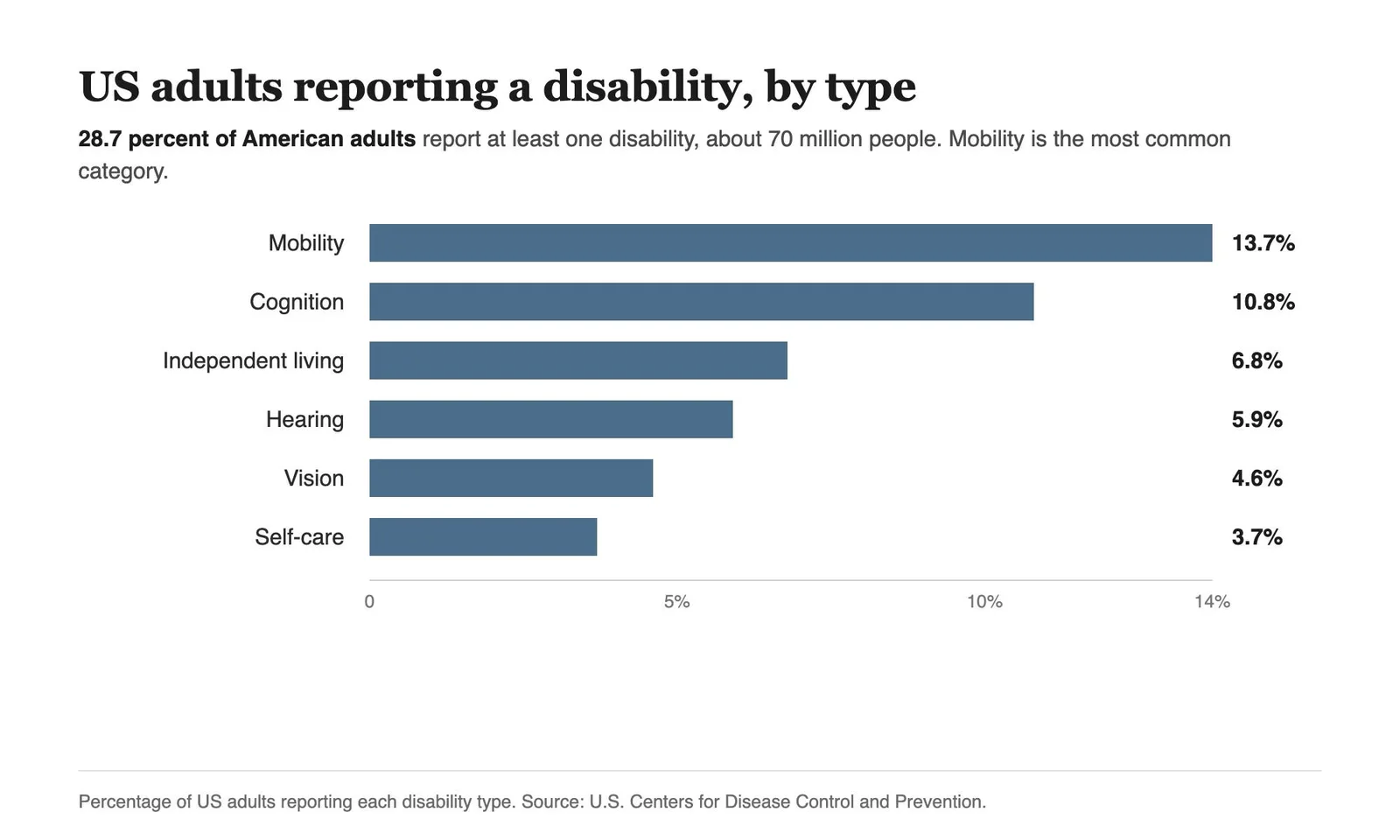
The federal numbers say this is not a rare scenario. The Centers for Disease Control and Prevention puts the share of American adults reporting a disability at 28.7 percent, and mobility is the most common category at 13.7 percent. Among adults 65 and older the overall rate is 43.9 percent. An eighty-person guest list with a normal age spread will contain people this affects.
The math changes what you should be renting
Here is where the compliance question turns into a planning question, and it is the part worth thinking through before calling a supplier.
Once a small event needs an accessible unit anyway, the comparison between a couple of standard portable units and a restroom trailer is not the comparison most hosts think they are making. An accessible portable unit is substantially larger than a standard one. It needs firm, level ground and a clear route to reach it. It occupies real space in a yard or a lot, and it is visible.
At that point the host is already accepting a footprint, a placement constraint, and a look. A restroom trailer, which carries multiple stations and generally reads as a more finished piece of equipment, starts competing on grounds beyond raw price. The comparison between portable units and restroom trailers turns less on cost per unit than on what the site can physically accommodate and what the event is trying to be.
None of that makes a trailer the right answer. Plenty of events are better served by basic units placed sensibly, especially where people are spread across a large area and a single central facility would mean a long walk. The point is narrower: the accessible-unit requirement changes the inputs, and a host who has not accounted for it is comparing the wrong two options.
The home-event version of the problem
Private residential events sit in a genuinely different position under the standard. An invitation-only gathering at a private home is generally not a public accommodation, so the federal requirements that cover ticketed and commercial events do not apply the same way. Booked at a public venue, most weddings are covered. In someone’s backyard, often not.
That is a legal distinction, not a practical one. A guest who cannot use the facilities has the same evening either way.
There is also a self-interested reason hosts land on trailers for home events that has nothing to do with compliance. The alternative to outdoor facilities is indoor traffic, which means a stream of guests through the house all evening. Louisiana hosts who have run a crawfish boil with the party kept outside tend to be firm about this after the first time.
Sizing is still the other half
Accessibility does not replace ordinary capacity planning, and under-ordering is its own failure.
Industry guidance from the Portable Sanitation Association International, which is trade practice rather than regulation, puts the working baseline near one standard unit per 50 guests for a four-hour event, scaling with duration. Alcohol service pushes consumption up enough that planners commonly add 15 to 20 percent. Where food is served, the guidance adds a handwash station for every four units.
Treat those as the point where a line starts forming rather than the point where guests are comfortable. An event with a long service window, an open bar, and a single restroom cluster will feel understocked at guidance minimums.
What to ask before you book
Three questions settle most of it, and none of them take long.
Ask whether your order includes an accessible unit, and if the answer is that you did not request one, ask what the unit count is. If it is one, the answer should change.
Ask what the site actually needs. Level ground, a clear route, and firm footing after rain are the three things that turn a compliant unit into an unusable one. A supplier who asks about your surface before quoting is telling you something useful.
Ask what happens on a two-day event. Servicing and refills are where multi-day events fail, and the answer should be a schedule with a name attached to it, not a reassurance.
The accessible unit is not an upgrade or a courtesy line item. On a small event it is frequently the only unit the standard actually requires, and it is the one most likely to be missing from the order.