


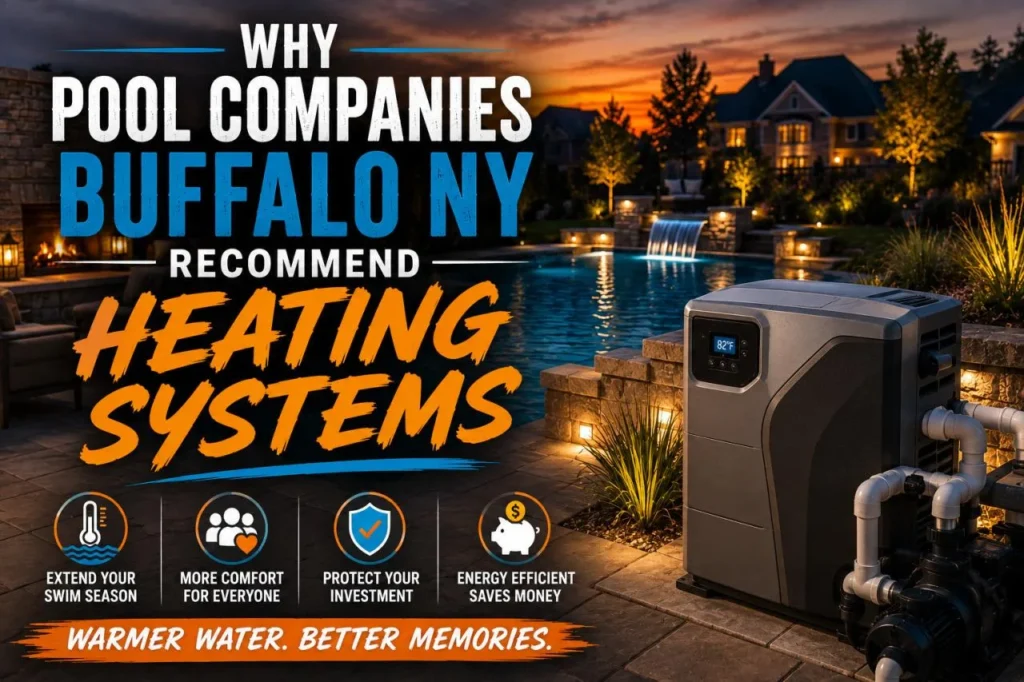
Owning a swimming pool in Buffalo comes with one unavoidable reality: the weather does not always cooperate with your plans.
Western New York can deliver beautiful summer afternoons that seem made for swimming, but temperatures can change quickly. Cool evenings, cloudy days, chilly mornings, and the shorter swimming season associated with the region can all influence how often homeowners actually use their pools.
This is where a pool heating system can make a noticeable difference.
Rather than relying entirely on sunshine to bring the water to a comfortable temperature, homeowners can use a heating system to create more predictable swimming conditions. The result is not simply warmer water. A properly selected system can potentially mean more usable pool days, greater flexibility, and better enjoyment of an investment that represents a significant part of the backyard.
Buffalo’s Climate Makes Pool Temperature Important
Swimming pool ownership looks different in Buffalo than it does in Florida or Southern California.
During the warmest parts of summer, an unheated pool may naturally reach comfortable temperatures. But conditions can change considerably during the beginning and end of the season.
Even during summer, overnight temperatures can lower water temperature.
A beautiful sunny afternoon does not necessarily mean the pool will immediately feel comfortable.
Heating provides homeowners with more control over that variable.
A Pool Heater Can Extend the Swimming Season
One of the biggest reasons homeowners consider pool heating is the possibility of using their pool beyond the hottest weeks of summer.
Without heating, swimmers are largely dependent on:
- Air temperature
- Sun exposure
- Overnight temperatures
- Recent weather
- Pool location
A heater can reduce that dependence.
Instead of waiting for several consecutive hot days, homeowners may be able to maintain more comfortable water conditions during cooler portions of the season.
More Pool Days Can Mean Better Value
An inground pool represents a substantial home improvement.
The real value of that investment isn’t only measured by how the backyard looks. It is also influenced by how frequently the family actually uses the pool.
Imagine two homeowners with similar pools.
One comfortably uses the pool primarily during the hottest summer period.
The other has equipment that allows the family to enjoy comfortable water across a longer portion of the swimming season.
The second homeowner may get considerably more use from essentially the same backyard space.
More usable days can make the pool feel like a more practical part of everyday life rather than a feature reserved for perfect weather.
Comfortable Water Encourages People to Actually Swim
There is a major difference between water being technically swimmable and water being inviting.
Children may jump into cooler water without thinking twice.
Adults are often less enthusiastic.
If everyone stands around the pool asking, “How cold is it?” before anybody gets in, the water temperature may be affecting how much the pool is actually being enjoyed.
A heating system allows homeowners to target a temperature that better matches their preferences.
Families May Have Different Temperature Preferences
Not everyone enjoys the same water temperature.
Competitive swimmers may prefer cooler water.
Families using a pool primarily for recreation may want something warmer.
Young children and older family members may also have different comfort preferences.
There is no single perfect swimming temperature for every household.
That is another advantage of heating: homeowners gain greater control over the environment rather than accepting whatever temperature the weather produces.
Morning Swimming Becomes More Appealing
Some people love starting the day with a swim.
The problem is that mornings can be one of the least appealing times to enter an unheated pool, particularly after a cool Buffalo night.
Heated water can make morning swimming considerably more comfortable.
For homeowners who use their pool for exercise rather than only weekend entertainment, that flexibility can be especially valuable.
Evening Swimming Can Become More Comfortable Too
Summer evenings are one of the best times to enjoy a backyard.
The sun is lower, the day’s responsibilities are finished, and the patio becomes a natural gathering place.
But once air temperatures fall, cooler pool water can become less appealing.
Heating can help maintain comfortable conditions after sunset, making evening swimming more practical for families and guests.
Pool Parties Become Less Weather-Dependent
Planning a backyard gathering around an unheated pool can feel like gambling with the weather.
You choose the date weeks in advance.
Then the forecast changes.
Maybe the afternoon is sunny but the previous several days were cool.
The pool may look perfect while feeling considerably colder than expected.
A heating system cannot control rain or thunderstorms, but it can provide more control over water temperature.
For homeowners who entertain frequently, that can make planning easier.
Heated Pools Can Be Better for Weekend Use
Many homeowners do not use their pools equally every day.
The weekend may be when the backyard gets the most activity.
If the weather has been cool throughout the week, waiting for the pool to warm naturally can consume part of the limited time available for swimming.
A properly operated heating system can help homeowners prepare the pool around when they actually plan to use it.
Heating Systems Aren’t All the Same
“Pool heater” is a broad term.
Different systems generate or capture heat differently, and the appropriate option depends on factors such as:
- Pool size
- Desired temperature
- Usage patterns
- Property conditions
- Available utilities
- Budget
- Efficiency priorities
This is why homeowners should compare technologies rather than simply purchasing whichever heater has the lowest initial price.
Gas Pool Heaters
Gas heaters are one established approach to pool heating.
They can heat water relatively quickly, which may appeal to homeowners who don’t maintain a consistently elevated temperature.
For example, someone who primarily uses the pool on weekends may want the ability to raise the temperature when needed.
Operating costs and fuel availability need to be considered alongside initial equipment costs.
Heat Pumps
Pool heat pumps operate differently from conventional gas heaters.
Rather than generating heat primarily through combustion, they transfer available heat from the surrounding air into the pool water.
Under appropriate conditions, this can provide an efficient way to maintain comfortable pool temperatures.
However, performance is influenced by environmental conditions.
That matters in Buffalo, particularly as outdoor temperatures decline.
Solar Heating
Solar pool heating uses available solar energy to help warm pool water.
The appeal is easy to understand.
Sunlight is free.
However, system effectiveness depends on factors including:
- Solar exposure
- Roof or property configuration
- Collector area
- Weather
- Desired water temperature
Solar heating can be worth considering in suitable situations, but homeowners should have realistic expectations about weather dependency.
The Best System Depends on How You Swim
Two Buffalo homeowners can own nearly identical pools and still need different heating strategies.
Consider one family that swims every day.
They may prioritize maintaining a relatively consistent temperature.
Another homeowner might use the pool mainly during:
- Weekends
- Parties
- Holidays
- Family visits
That person may prioritize the ability to heat the water when necessary rather than maintaining the same temperature continuously.
Usage patterns should influence equipment decisions.
Pool Size Matters
Larger pools contain more water.
More water generally means more energy is required to change the temperature.
When evaluating heating equipment, homeowners need to consider the actual volume and characteristics of their pool.
An undersized system may struggle to deliver the expected performance.
Oversizing without considering the broader system can also be unnecessary.
Proper equipment selection matters.
Surface Area Matters Too
Heat loss occurs at the pool surface.
A large pool with significant exposed surface area can lose substantial heat, particularly under cooler or windy conditions.
This is one reason heating should not be considered independently from heat retention.
Generating heat efficiently matters.
Keeping that heat in the water matters too.
Pool Covers Can Make Heating More Effective
A pool cover can play an important role in a heating strategy.
When the pool is uncovered, evaporation can contribute significantly to heat loss.
Covering the pool when it isn’t being used can help retain heat and reduce evaporation.
This can mean the heating system has less work to do to maintain or restore the desired temperature.
Heating Without Managing Heat Loss Can Waste Energy
Imagine heating the pool throughout the afternoon and then leaving it completely exposed through a cool night.
By morning, some of that heat has been lost.
The heater then needs to replace it.
Repeated daily, that cycle can increase energy consumption.
Homeowners should therefore think about heating as a complete system:
Generate heat + retain heat + operate equipment intelligently.
Wind Can Influence Heat Loss
Wind moving across the water surface can increase evaporation and contribute to cooling.
Properties with open exposure may experience different conditions from pools surrounded by structures, landscaping, or other forms of shelter.
This doesn’t mean homeowners should completely block airflow around the pool.
It simply demonstrates that site conditions influence heating performance.
Landscaping Can Affect Pool Temperature
Pool landscaping is usually discussed in terms of appearance and privacy.
But the surrounding environment can also influence sun and wind exposure.
Trees, structures, fences, and other landscape elements may affect how much direct sunlight reaches the pool during different parts of the day.
These factors can be worth considering when planning both a new pool and its heating strategy.
Darker Surfaces May Affect Heat Absorption
Pool finish and surrounding conditions can influence how sunlight interacts with the pool environment.
However, homeowners should not select a finish based exclusively on potential temperature effects.
A pool finish also influences:
- Appearance
- Water color
- Texture
- Maintenance
- Overall backyard design
Heating should be handled primarily through properly designed equipment rather than relying on finish color alone.
Automatic Controls Can Make Heating Easier
Modern pool equipment can provide more convenient control than older systems.
Depending on the equipment configuration, homeowners may be able to manage temperature settings and schedules through automated controls.
This can make it easier to coordinate heating with actual pool use.
Instead of manually adjusting equipment constantly, the system can operate according to a more consistent plan.
Smart Scheduling Can Reduce Unnecessary Operation
Heating an unused pool indefinitely may not make sense for every homeowner.
If the family consistently swims at predictable times, equipment schedules may help align operation with those habits.
For example, a household that primarily uses the pool during weekends may choose a different strategy from someone who swims every morning.
The ideal schedule depends on:
- Equipment
- Weather
- Desired temperature
- Pool characteristics
- Usage patterns
Energy Efficiency Should Be Part of the Conversation
Heating water requires energy.
That makes efficiency an important consideration.
When comparing systems, homeowners should look beyond the purchase price.
Consider:
- Expected operating costs
- Equipment efficiency
- Maintenance
- Lifespan
- Heating speed
- Climate suitability
A less expensive unit initially may not necessarily be the least expensive option over years of operation.
Operating Costs Can Vary Considerably
There is no universal answer to what it costs to heat a Buffalo swimming pool.
Costs can depend on:
- Pool volume
- Target temperature
- Outdoor temperature
- Fuel or electricity prices
- Heater type
- Pool cover use
- Wind exposure
- Swimming season length
- Equipment efficiency
Be cautious of anyone promising an exact operating cost without knowing the details of the pool and property.
A Few Degrees Can Make a Difference
Homeowners sometimes assume that maintaining extremely warm water is necessary to justify installing a heater.
That isn’t always the case.
For some families, the difference between water that feels slightly too cold and water that feels comfortable may only be several degrees.
Finding your preferred temperature can help avoid unnecessary energy consumption.
Warmer Isn’t Automatically Better
Turning the temperature higher does not necessarily improve the swimming experience.
Very warm pool water can feel less refreshing during hot weather.
The objective should be comfort rather than maximum temperature.
Experiment with settings until you find what works for your household.
Heating Can Support Exercise
Swimming is one reason people install pools beyond recreation.
Homeowners may use their pools for:
- Lap swimming
- Low-impact exercise
- Aquatic workouts
- General movement
Consistent water conditions can make it easier to maintain a swimming routine even when Buffalo weather becomes unpredictable.
Heating Can Make the Pool More Useful for Older Adults
Some people are more sensitive to cold water than others.
A pool that children consider perfectly comfortable may feel unpleasant to older adults.
Having temperature control can make the backyard more welcoming to a wider range of family members and guests.
Consider Heating During Initial Pool Design
The easiest time to think about pool heating is often before the pool is built.
Planning ahead allows the project team to consider:
- Equipment location
- Utility requirements
- Plumbing
- Electrical needs
- Controls
- Equipment pad space
Adding equipment later may still be possible, but planning for it initially can simplify installation.
Existing Pools Can Often Be Evaluated for Heating
Homeowners with existing pools can also explore heating options.
The first step is understanding the current system.
A professional evaluation may consider:
- Pool size
- Existing plumbing
- Electrical capacity
- Gas availability
- Equipment pad
- Circulation system
- Property conditions
That information helps determine which options are practical.
Equipment Location Matters
Pool equipment needs appropriate placement for operation, service, and safety.
Heating equipment may also have installation requirements involving factors such as:
- Clearance
- Ventilation
- Utility connections
- Drainage
- Service access
The correct setup depends on the type of equipment and manufacturer requirements.
Professional Sizing Is Important
Choosing a heater based only on online reviews can be risky.
A system that performs well for one homeowner may be poorly suited to another pool.
Experienced pool companies buffalo ny can evaluate factors such as pool size, equipment configuration, desired temperature, property conditions, and typical swimming habits before recommending an appropriate heating approach.
The objective should be matching the system to the pool rather than simply choosing the most powerful or least expensive unit.
Installation Quality Affects Performance
Even excellent equipment can perform poorly if the overall installation is flawed.
Pool heating interacts with:
- Plumbing
- Circulation
- Filtration
- Electrical systems
- Gas lines when applicable
- Automation
Proper installation helps the components work together as intended.
Maintenance Should Be Considered Before Buying
Pool heating equipment requires ongoing attention just like other mechanical systems.
Maintenance needs vary according to the technology.
Homeowners should ask:
- What routine maintenance is required?
- How frequently should the system be inspected?
- What components commonly wear?
- Who services the equipment locally?
- What does the warranty cover?
These questions help reveal the true ownership experience.
Water Chemistry Can Affect Equipment
Balanced pool water isn’t only important for swimmers and the pool finish.
Improper chemistry can potentially affect equipment and plumbing components over time.
Maintaining appropriate water chemistry should remain part of overall pool care whether the pool is heated or not.
Don’t Ignore Manufacturer Requirements
Pool equipment manufacturers establish specific installation, operation, and maintenance requirements.
Following these instructions can affect:
- Performance
- Safety
- Reliability
- Warranty coverage
Homeowners and installers should use the specifications for the actual equipment rather than relying on assumptions from another model.
Heating and Automation Work Well Together
A modern backyard may include integrated controls for:
- Pump
- Heater
- Lighting
- Water features
- Other pool equipment
Centralized controls can simplify pool operation.
Instead of interacting with several separate systems, homeowners may be able to manage major functions from a single interface, depending on the equipment installed.
Consider the Entire Equipment Pad
If you are building a new pool, avoid planning each piece of equipment independently.
The:
Pump, filter, heater, sanitizer, valves, and controls
need to function as part of one circulation system.
Thoughtful equipment-pad design can also make future maintenance easier.
A Heater Doesn’t Eliminate the Need for Good Pool Design
Heating cannot compensate for every problem.
A well-designed pool should still consider:
- Sun exposure
- Circulation
- Equipment sizing
- Drainage
- Landscaping
- Pool cover options
- Maintenance access
Heating is one component of a broader backyard system.
Think About the Pool’s Actual Purpose
Before investing in heating, ask why you built or bought the pool.
If the answer is:
“We want the family swimming as often as possible,”
heating may be especially valuable.
If you only swim occasionally during the hottest days of summer, the economics may look different.
Equipment decisions should support the way you actually live.
Heating Can Make Entertaining Easier
A backyard pool often becomes a gathering place.
Families may host:
- Birthday parties
- Cookouts
- Weekend gatherings
- Holiday celebrations
- Evening dinners
Having greater control over water temperature can remove one variable from event planning.
You still cannot control Buffalo weather, but at least the pool doesn’t have to depend entirely on several consecutive hot days.
Don’t Wait Until Guests Arrive
If you plan to heat the pool for an event, understand how long your particular system requires to reach the desired temperature.
Heating is not always instantaneous.
Factors such as:
- Starting water temperature
- Pool size
- Heater capacity
- Weather
can influence the process.
Plan ahead rather than turning on the system shortly before everyone arrives.
Heating Doesn’t Mean the Pool Must Stay Warm Constantly
One misconception is that installing a heater means maintaining warm water 24 hours a day throughout the entire season.
Not necessarily.
The ideal operating strategy depends on the heating technology and how frequently the pool is used.
Some households may maintain a consistent temperature.
Others may heat strategically around swimming periods.
Discuss the appropriate approach for your equipment.
Consider Long-Term Ownership Costs
A heating system should be evaluated as a long-term investment.
The total cost can include:
Purchase + installation + energy + maintenance + repairs.
Understanding the complete ownership picture makes it easier to compare options fairly.
The cheapest initial proposal isn’t automatically the lowest-cost solution over time.
Ask for Several Options
When discussing heating for a new or existing pool, ask the contractor to explain alternatives.
You might compare:
- Initial price
- Expected performance
- Operating characteristics
- Maintenance
- Equipment lifespan
- Heating speed
Understanding the tradeoffs allows you to choose based on your priorities.
Don’t Choose Based Only on BTUs or Specifications
Technical specifications matter, but bigger numbers don’t automatically mean better equipment for your pool.
System design should account for actual conditions.
A properly selected system can often provide a better ownership experience than simply purchasing equipment based on the largest advertised capacity.
Pair Heating With Good Habits
Technology works best when homeowners use it intelligently.
Helpful habits can include:
- Using an appropriate pool cover
- Maintaining equipment
- Keeping water chemistry balanced
- Following sensible temperature settings
- Scheduling heating according to usage
Small operational choices can influence overall efficiency.
A Heated Pool Can Change How You Use the Backyard
The most important benefit may be behavioral.
Without heating, homeowners may look outside and ask:
“Do you think the pool is warm enough?”
With greater temperature control, the question becomes:
“Do you want to swim?”
That difference can lead to more spontaneous use of the backyard.
The Goal Is More Enjoyment, Not More Equipment
A heating system shouldn’t be installed simply because another homeowner has one.
Every piece of pool equipment should solve a practical problem.
In Buffalo, that problem is often straightforward:
The weather doesn’t always keep pool water at the temperature homeowners want.
Heating provides one way to address that issue.
Questions to Ask Before Installing a Pool Heater
Before choosing equipment, ask:
- What heating systems work well for this pool?
- How was the recommended size calculated?
- What operating costs should I realistically expect?
- How quickly can the system heat the pool?
- How does outdoor temperature affect performance?
- Should I use a pool cover?
- What maintenance is required?
- What utilities are necessary?
- What warranty is included?
- Can the heater integrate with existing controls?
A good discussion should help you understand the tradeoffs rather than simply push one piece of equipment.
FAQs
Is a pool heater useful in Buffalo NY?
It can be particularly useful for homeowners who want greater control over water temperature and potentially more comfortable swimming during cooler portions of the season.
Can heating extend the Buffalo swimming season?
A properly selected heating system can help maintain more comfortable water temperatures when natural conditions would otherwise leave the pool too cool for a household’s preferences. Actual results depend on weather, equipment, pool characteristics, and desired temperature.
What types of pool heating systems are available?
Common options include gas heaters, heat pumps, and solar-based systems. Each has different installation requirements, operating characteristics, and climate considerations.
Does a pool cover help when using a heater?
A cover can help reduce evaporation and heat loss when the pool isn’t being used, potentially allowing the heating system to operate more effectively.
How much does it cost to heat a swimming pool in Buffalo?
There is no single answer. Operating costs depend on pool size, heating technology, target temperature, weather, energy prices, cover use, and how frequently the system operates.
Final Thoughts
Buffalo homeowners cannot control when a cold night arrives or when several cloudy days lower the pool temperature.
They can, however, have more control over the water itself.
A properly selected heating system can make morning swims more comfortable, evening swimming more inviting, weekend plans more predictable, and the overall swimming season more flexible.
The key is choosing equipment based on the actual pool and how the household intends to use it.
Pool size, desired temperature, utility availability, equipment efficiency, heat loss, maintenance requirements, and operating costs should all be part of the decision.
Combine an appropriate heating system with good circulation, sensible temperature settings, regular maintenance, and effective heat retention, and the result can be something much more valuable than simply warmer water.
It can mean more days when the backyard pool is actually ready to be enjoyed.