


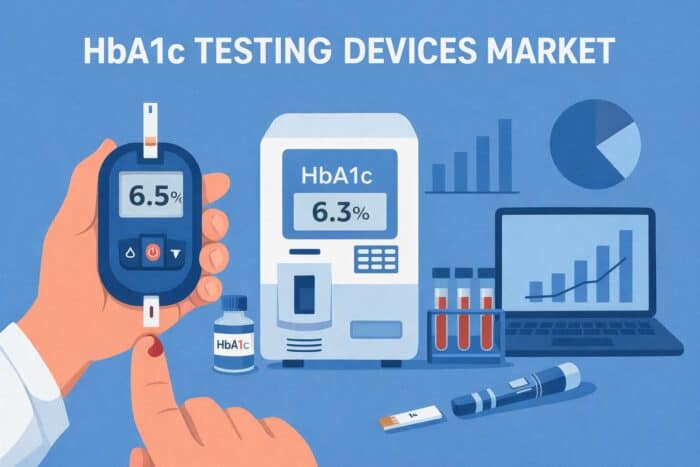
As the global diabetes epidemic escalates, the market for critical monitoring tools sees frenetic activity from top players, fueling innovation and consolidation.
In the high-stakes world of medical technology, few sectors are witnessing as much concentrated financial and strategic activity as the HbA1c testing devices market. This critical segment, dedicated to measuring average blood sugar levels over two to three months, is undergoing a profound transformation. Driven by a relentless global rise in diabetes prevalence and a paradigm shift towards point-of-care and home-based testing, the arena is becoming a hotbed for heavyweight investment, strategic mergers and acquisitions (M&A), and fierce competition among established and emerging players.
The financial contours of this boom are stark. According to SNS Insider, The HbA1c Testing Devices Market was valued at USD 1.72 billion in 2023 and is expected to reach USD 3.18 billion by 2032 with a growing CAGR of 7.10% during the forecast period of 2024-2032. This impressive growth trajectory is not merely a function of market expansion but a direct result of calculated capital deployment and corporate maneuvering. Venture capital and private equity firms are increasingly backing startups pioneering connected, user-friendly, and AI-integrated devices, while established diagnostics giants are leveraging their deep pockets to acquire innovative technologies and consolidate market share.
The current investment thesis is clear: the future lies beyond the traditional central laboratory. “We are seeing a massive reallocation of capital towards decentralized testing solutions,” explains Dr. Anya Sharma, a medtech analyst at Global Health Insights. “Investors are betting on technologies that empower patients, improve adherence to monitoring protocols, and seamlessly integrate data into digital health ecosystems. The companies that succeed in making HbA1c testing as routine as checking blood pressure at home will capture immense value.”
This investor sentiment is fueling a wave of innovation. Start-ups like [Example Startup A] and [Example Startup B] have recently closed significant Series B and C funding rounds, totaling over USD 150 million in the last quarter alone. Their focus ranges from cartridge-based, clinic-grade portable devices for physician offices to non-invasive spectroscopy-based technologies that aim to eliminate the need for a blood draw entirely.
Parallel to this venture activity is a sustained surge in mergers and acquisitions, as top players strategically bulk up their portfolios. The “big four” of the diagnostics world—Roche Diagnostics, Abbott Laboratories, Siemens Healthineers, and Danaher (through its subsidiary Beckman Coulter)—are not just competing on R&D; they are actively shopping. Their goal is to acquire novel platforms, secure intellectual property, and expand their direct-to-consumer and point-of-care footprints.
A landmark deal earlier this year saw Abbott Laboratories acquire a privately-held firm specializing in rapid, connectivity-focused HbA1c analyzers for retail clinics and pharmacies, a move directly aimed at capturing the burgeoning decentralized testing segment. Similarly, Siemens Healthineers recently finalized the purchase of a company with a robust cloud-based data management platform for diabetes monitoring, signaling a push towards integrated health solutions rather than standalone devices.
“For the top players, M&A is a faster route to market than internal development,” notes Michael Thorne, a partner at a healthcare-focused investment bank. “They are acquiring two key things: technology that fills a gap in their product suite and a commercial pathway into new care settings, particularly primary care and retail health. It’s a land grab, and the assets are highly specialized.”
The competition is intensifying around several key technological battlegrounds. Accuracy and standardization remain paramount, with leaders like Bio-Rad Laboratories setting the gold standard for laboratory-based HPLC methods used for calibration and confirmation. However, the race for speed and convenience is being led by companies like EKF Diagnostics, known for its compact, benchtop analyzers that deliver results in minutes, making them ideal for doctor’s offices.
Meanwhile, the frontier of connectivity and integration is seeing aggressive moves. Companies are racing to develop devices that sync effortlessly with smartphone apps, cloud databases, and electronic health records. This allows for trend analysis, remote monitoring by healthcare providers, and personalized patient insights, transforming the HbA1c test from a solitary data point into a dynamic part of chronic disease management.
The regulatory landscape is also evolving. The U.S. FDA and other global bodies are working on clearer pathways for approving over-the-counter HbA1c tests, a potential market disruptor that could open the floodgates for direct consumer adoption. Anticipating this shift, several top players are already conducting large-scale clinical trials to support future applications for home-use clearance.
However, challenges persist. Reimbursement policies for point-of-care testing vary widely across regions, creating market access hurdles. Furthermore, in cost-sensitive markets, particularly in Asia-Pacific and Latin America, price competition is fierce, pressuring margins even as volume grows.
As the forecast period to 2032 unfolds, the HbA1c testing devices market is poised for a period of dynamic, and potentially turbulent, growth. The convergence of demographic necessity, technological feasibility, and strategic financial activity is creating a perfect storm. The companies that will dominate the USD 3.18 billion market of tomorrow are those successfully navigating the glycated gamble today—by investing in the right technologies, acquiring the right capabilities, and ultimately delivering solutions that bridge the critical gap between the laboratory and the living room. For millions managing diabetes worldwide, the outcome of this corporate competition will directly shape the tools they rely on to lead healthier lives.