


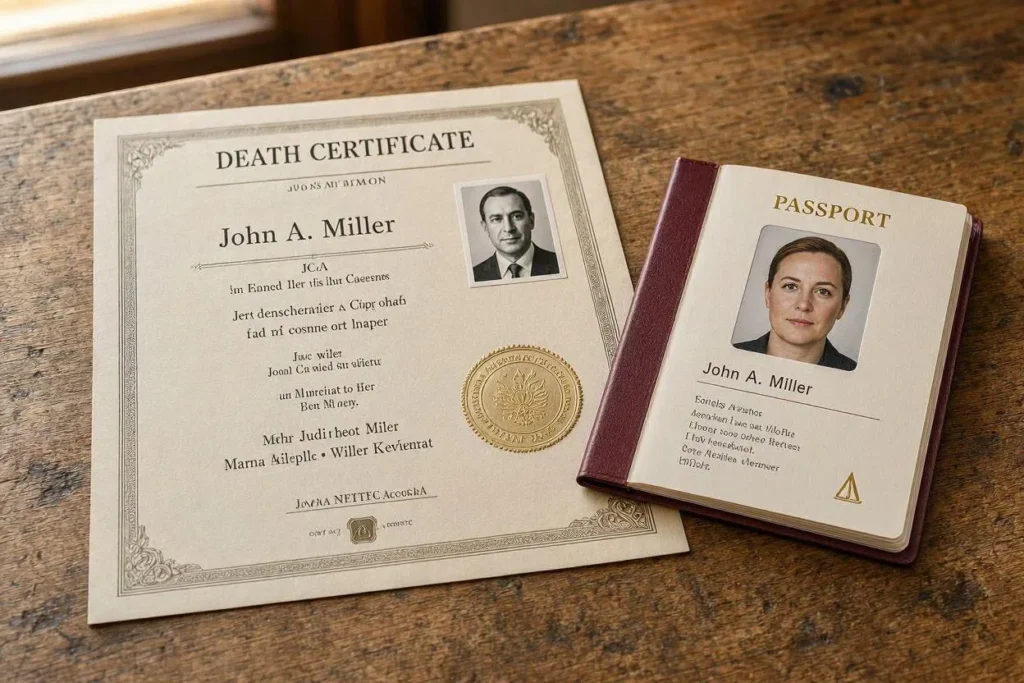
Comparing passport application information with deceased-person records can help authorities flag suspected “ghosting,” a form of identity theft involving a deceased individual’s personal details, while further review distinguishes possible impersonation from inaccurate records and routine administrative errors.
WASHINGTON, DC, October 4, 2026 — Death records can reveal a fundamental conflict in a passport application: someone is seeking a travel document under an identity associated with a person reported deceased, creating a question that requires careful examination before officials determine what happened.
The apparent contradiction can point toward identity theft, but it does not establish fraud by itself, because an incorrect death report, a mistaken association between records or inaccurate application information can also produce a discrepancy requiring resolution.
The value of the comparison lies in bringing that conflict to attention, allowing officials to examine whether the applicant owns the claimed identity and whether the records accurately describe the person seeking the passport.
For travelers and families, understanding this process requires separating three issues that are easily confused: the existence of a death record, the accuracy of its connection to an applicant and the evidence needed to establish deliberate impersonation.
What “Ghosting” Means in an Identity Fraud Case
In this context, ghosting describes a living person using a deceased person’s identity, presenting personal information associated with the deceased as though it described their own history.
The deception concerns ownership of the identity, meaning some underlying information may accurately describe a real person even though the person presenting it has no legitimate basis to claim to be that person.
That distinction explains why identity fraud does not always depend on obviously fabricated paperwork, since genuine historical records can become part of a false application when someone misrepresents their relationship to the individual those records describe.
A document examiner and an identity reviewer therefore face connected but different questions, because determining that a record is authentic does not independently establish that the applicant is entitled to use its identifying information.
A Real Record Can Support a False Claim
Consider the general evidentiary problem posed by a birth record: it can document the circumstances of an actual birth while providing no current photograph or independent assurance that the adult presenting it is the person named.
Death information adds another piece to that history, potentially indicating that the subject of the birth record cannot be the living applicant, although officials must establish that the relevant records actually concern the same individual.
The resulting question is not simply whether a document looks official, but whether the applicant’s claimed identity remains coherent when examined alongside reliable information about the life and death of the person identified in the paperwork.
This is why a convincing collection of documents cannot substitute for establishing ownership of an identity, especially when those documents repeat information whose connection to the applicant has never been independently demonstrated through reliable evidence.
What Published Passport Oversight Has Documented
A Government Accountability Office report published in 2014 described State Department comparisons involving Social Security information and death records, documenting their role in identifying passport applications that could require closer examination because of conflicting identity information.
The report examined approximately 28 million passport issuances from fiscal years 2009 and 2010, making its findings historical evidence about screening and oversight rather than a measurement of the passport system’s effectiveness or technical configuration today.
GAO identified potentially problematic cases but did not find pervasive fraud in the populations it reviewed, and its findings included likely data errors, underscoring the difference between an apparent records conflict and confirmed misconduct.
Those qualifications matter because an oversight report can show a screening method’s usefulness without establishing that every resulting match represents impersonation, or that the same findings describe applications submitted many years after the review.
A Screening Result Begins an Inquiry
The general purpose of a records comparison is to identify information that deserves attention, while the subsequent review must determine whether the apparent connection is accurate and what it means for the application under consideration.
An automated result cannot explain every historical circumstance behind a record, so it is necessary to distinguish the system’s observation from the official conclusion reached after considering relevant documents, explanations, and other evidence.
That distinction matters especially when the possible consequence involves questioning someone’s identity, because a database association can affect a legitimate applicant even when the underlying problem originated elsewhere and the applicant provided truthful information.
A sound interpretation therefore treats the discrepancy as a question to resolve, preserving the possibility of identity theft without assuming the most serious explanation is necessarily correct before the supporting evidence has been examined.
Death Information Comes From Administrative Reporting
The Social Security Administration explains that it receives death reports from sources including relatives, funeral homes, financial institutions, states, and other federal agencies, reflecting that death information enters administrative systems through several reporting channels.
The agency also cautions that its records are not a comprehensive register of every death in the country, an important limitation when discussing what any individual database can establish about a person’s life history.
Its published guidance distinguishes death-information files by content and permitted access, showing why the phrase “death database” should not be treated as a precise description of one identical resource available to every organization.
For passport screening, the relevant point is that information must be interpreted in its proper context, with attention to a record’s source and meaning rather than assuming a database entry explains itself.
An Entry and a Conclusion Are Different Things
A death-related entry communicates information recorded by a system, while a conclusion about an applicant requires establishing that the entry concerns the claimed identity and accurately represents the circumstances relevant to the pending application.
The presence of information in several records does not necessarily make every repetition an independent confirmation, because the evidentiary question remains whether those records accurately describe the person and events officials are trying to verify.
For the same reason, public discussion should avoid equating technological speed with certainty, since a rapid comparison may efficiently identify a conflict while leaving the underlying factual question dependent on careful examination and reliable supporting evidence.
Accuracy is therefore part of the fraud-control function itself, because resolving an incorrect association helps distinguish legitimate applicants from impersonators rather than leaving both groups mixed together in an unexplained collection of alerts.
Why an Apparently Deceased Applicant May Be Alive
An applicant associated with a death record may be alive if their information was recorded incorrectly, so correcting the record is necessary before anyone concludes the application involves a stolen identity.
Another possibility is that the comparison linked the wrong records, creating an identification problem rather than proof that the applicant knowingly claimed the identity of someone who has died.
These explanations differ from ghosting because the applicant may be using their own identity truthfully, even though the information available to an official contains a contradiction that prevents the application from being resolved without further work.
For the affected person, the practical challenge is to identify the specific error and obtain appropriate correction or confirmation, rather than assume that submitting additional unrelated documents will explain a problem whose origin remains unclear.
Correction Should Address the Source of the Problem
Social Security has publicly advised people who believe they have been incorrectly listed as deceased to contact their local office, providing an official starting point for addressing a suspected error in that agency’s own records.
An applicant should also respond to any passport-related request according to the instructions actually received, because communicating with one agency does not necessarily answer the separate questions another agency has raised about the pending application.
Keeping copies of correspondence and correction documents can make those discussions more precise, allowing the individual to explain which record was disputed, what action was taken and what confirmation has been supplied by the responsible authority.
The goal is to restore an accurate documentary history, with each explanation grounded in the person’s actual circumstances rather than an improvised attempt to make inconsistent information appear compatible without resolving the underlying administrative problem.
A Maine Case Illustrates Deceased-Person Identity Theft
In August 2023, The Associated Press reported on Napoleon Gonzalez’s conviction for offenses including passport fraud after authorities said the Maine resident had used his deceased brother’s identity to obtain passports and collect benefits under different identities.
The reported investigation began after Maine motor-vehicle facial recognition technology connected the same face to two identities in 2020, meaning the case illustrates deceased-person impersonation without establishing that a passport death-record comparison generated the initial lead.
That distinction preserves the difference between the type of fraud and the method that exposed it, because a case involving a deceased identity can begin with photographic evidence, documentary questions or another investigative development entirely.
More broadly, an identity claim can persist across several kinds of records while still being false, so officials must independently examine the claimant when reliable evidence calls the claimed history into question.
Death Records Complement Other Identity Evidence
A death-record comparison addresses one aspect of the applicant’s claimed history, while identification documents, photographs, and citizenship evidence address other questions that officials must understand together when evaluating whether the application supports issuance.
A photograph can help connect a living person to an identification record, but it does not independently establish citizenship or explain whether the historical information associated with that identity accurately belongs to the person depicted.
Likewise, a citizenship document can support a claim about its subject’s status without independently proving that the presenter is that subject, which is why document authenticity and identity ownership remain separate considerations throughout review.
The strength of using several types of evidence lies in their ability to answer different questions, rather than in treating any single source as an infallible test whose result settles every aspect of passport eligibility.
The Applicant’s Explanation Must Fit the Evidence
When a conflict appears, a useful explanation identifies what is wrong and supports the correction with appropriate evidence, enabling officials to understand the relationship between the applicant, the disputed information and the records being reviewed.
An explanation should not be evaluated solely by how detailed or persuasive it sounds, because the relevant question is whether reliable documents and verifiable circumstances support the account of why the apparent inconsistency exists.
This is particularly important when someone claims that another person’s records actually belong to them, since the distinction between an administrative mistake and impersonation depends on establishing the truth of that claimed connection through supporting evidence.
Legitimate applicants are best served by accurate descriptions of their circumstances, including acknowledgment of any genuine uncertainty, rather than supplying an invented explanation intended to anticipate what they believe a reviewer would prefer to hear.
A Fraud Concern Is Different From a Conviction
A records discrepancy, a request for additional information and a criminal allegation communicate different stages of factual development, so none should be substituted for another when describing an applicant’s position or an agency’s action.
A death-related conflict does not, by itself, establish who submitted an application, whether the information was knowingly false, or whether the evidence supports the elements of a particular criminal offense under applicable law.
Those questions explain why public reporting should identify the specific action authorities have announced, preserving the distinction between unresolved evidence, suspected misconduct and a finding established through the appropriate legal process in an individual case.
The same care should apply to applicants discussing their own experience, because describing every delay as a fraud investigation can create unnecessary confusion about what officials have actually asked and what remains to be resolved.
Families Have an Interest in Accurate Identity Records
Misuse of a deceased relative’s identity can create distress beyond the immediate passport issue, particularly when surviving family members encounter unfamiliar correspondence or information that appears inconsistent with the relative’s known history and documented death.
Families should preserve relevant material and consult the appropriate official reporting channels when they suspect misuse, allowing the responsible authorities to assess the information instead of attempting to investigate or confront an unknown person themselves.
An unusual letter or administrative notice does not establish a complete fraud case, but it can provide information worth retaining, especially when it identifies a specific transaction or identity claim that the family cannot explain.
Careful handling also means limiting unnecessary distribution of sensitive records, because reporting a concern should provide the information the receiving authority needs without broadly exposing the deceased person’s documents or surviving relatives’ personal details.
Lawful Citizenship Planning Requires Truthful Identity Claims
Additional citizenship and international relocation involve legitimate questions about eligibility and documentation, but they do not change the distinction between establishing a lawful entitlement in one’s own circumstances and adopting a deceased person’s identity.
Amicus International Consulting’s second-passport services page discusses citizenship and passport planning, a subject in which clients should insist on understanding the legal basis for eligibility and the government process that decides their application.
Any proposed arrangement should be evaluated according to the truth of its underlying claims, because official-looking paperwork cannot make an invented birthplace, false family history or another person’s identity an accurate description of the applicant.
The same distinction applies to Amicus International Consulting’s tax identification number services, since an administrative identifier serves a specific purpose and does not independently establish that a person owns every identity detail associated with it.
For advisers and clients, the useful standard is whether each document accurately supports the claim being made, with legitimate privacy concerns addressed through lawful practices that preserve truthful disclosures and valid connections between people and records.
The Value Lies in Resolving the Contradiction
Death records contribute to passport integrity by introducing information that may challenge an identity claim, but their practical value depends on determining whether the apparent contradiction reflects impersonation, inaccurate reporting or an incorrect connection between records.
That process requires both attention to possible fraud and a workable path for legitimate applicants to correct mistakes, because identifying suspicious information is useful only when officials can reliably distinguish its possible explanations.
Historical oversight and documented prosecutions show why deceased-person identity misuse deserves scrutiny, while the possibility of administrative error explains why a match should remain an evidentiary question until further examination establishes its meaning.
For applicants, the central obligation remains to use their own identity, provide accurate supporting information and respond truthfully when records conflict, allowing officials to assess the actual person and circumstances behind the passport application.