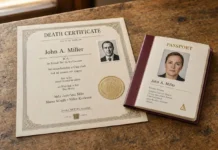
The steep price of a fresh start, how faking your demise can lead to warrants, arrests, restitution orders, felony charges, and significant prison sentences once investigators uncover the truth.
WASHINGTON, DC
Faking your death may appear to offer a final escape from debt, scandal, legal pressure, family conflict, online exposure, professional collapse, or financial ruin, but in the United States, it can quickly become a criminal case once police, courts, banks, insurers, creditors, tax authorities, or government databases are misled.
There is generally no single federal statute titled “faking your death,” yet pseudocide usually produces criminal exposure through the surrounding conduct, including insurance fraud, wire fraud, mail fraud, bank fraud, false statements, identity theft, passport fraud, obstruction, computer intrusion, tax evasion, unpaid support avoidance, and conspiracy.
That distinction matters because a person may legally move away, reduce contact, close public accounts, change a name through lawful procedures, and live privately, but cannot fabricate death evidence, manipulate official records, collect money, defeat court orders, or deceive public agencies without risking arrest.
The road to prison usually begins when the fake death causes someone else to act.
A private adult can usually relocate, stop answering calls, leave a job, change phone numbers, and withdraw from public life without committing a crime simply by becoming harder to find.
The criminal problem begins when the person creates a false death narrative that causes police to search, insurers to review claims, courts to pause proceedings, creditors to suspend collection, banks to change accounts, or relatives to begin estate decisions.
Once another person or institution relies on the false death, prosecutors can argue that the disappearance was not private withdrawal, but a scheme designed to obtain advantage, avoid obligations, waste public resources, or interfere with lawful systems.
This is why fake-death cases often lead to warrants and arrests, because investigators are not merely looking for a missing person, but reconstructing a possible fraud trail through documents, messages, financial records, travel activity, and official filings.
Insurance fraud is one of the clearest ways pseudocide leads to prison.
Life insurance turns a staged death into a direct financial crime when a beneficiary, spouse, business partner, or co-conspirator seeks payment based on a death that never happened.
In one major federal case, a Jacksonville businessman received a 14-year prison sentence after prosecutors said he faked his death in connection with bank fraud and conspiracy to commit mail and wire fraud, according to the Justice Department’s official sentencing announcement.
That sentence was not imposed because the defendant privately wanted to disappear, because the case involved financial institutions, false representations, victims, restitution, and a wider course of conduct that converted a staged death into an economic crime.
Once a fake death is connected to insurance proceeds, lender losses, asset concealment, unpaid debts, or business deception, the legal system usually treats the conduct as theft through fraud rather than an unusual attempt at personal reinvention.
False death records can turn a disappearance into a cybercrime and identity case.
Modern pseudocide often depends on official records, because banks, courts, insurers, child-support systems, tax offices, and government databases may need formal death information before changing a person’s status.
When a person manipulates a death registry, misuses official credentials, creates false certifications, or causes a government database to record a living person as deceased, the case can become a technology crime as well as a fraud case.
False death records are especially damaging because they can spread across tax files, benefit systems, bank accounts, court enforcement, medical records, child-support databases, credit files, and identity verification systems that rely on accurate life-status information.
The cleanup burden can last long after the arrest, because government agencies, banks, courts, family members, and victims may need months or years to correct records that were altered by a false death.
Police searches can create jail time even when no insurance money is collected.
Not every staged death begins with an insurance policy, because some people fake drownings, suicides, boating accidents, hiking disappearances, or violent incidents to escape family pressure, debt, scandal, or emotional crisis.
A staged disappearance can trigger search teams, emergency responders, divers, aircraft, drones, volunteers, medical examiners, public alerts, and investigators who spend public resources responding to a manufactured emergency.
In a widely reported Wisconsin case, a man who faked his drowning received jail time and was ordered to pay restitution after authorities spent significant resources searching for him, as described in Associated Press coverage.
That case shows why a death hoax can lead to punishment even without a large financial payout, because misleading police, diverting rescue resources, and traumatizing family members can create serious legal consequences.
Warrants often follow when investigators realize the missing person is alive.
At the beginning of a staged disappearance, police may treat the matter as a missing-person investigation, but that posture can change quickly when financial records, digital activity, witness accounts, or travel data suggest the person is alive.
Once investigators believe the death was fabricated, they may pursue arrest warrants based on false reporting, obstruction, fraud, identity misuse, unpaid support avoidance, computer offenses, or related state and federal charges.
The shift can be dramatic because the person who expected sympathy may become the target of a criminal investigation, while relatives, friends, employers, banks, insurers, and government offices become witnesses.
For prosecutors, the case often becomes easier when the person resurfaces, because survival itself is not the only evidence, since the documents and communications used to support the death narrative can show intent.
Passport fraud can add serious federal exposure after the fake death.
A person who pretends to be dead still needs housing, banking, employment, healthcare, phone service, travel, insurance, and ordinary identity documents, which often pushes the hoax toward fraudulent applications or stolen identity material.
A passport is not merely a travel booklet, because it is a government identity instrument tied to citizenship, biometrics, consular protection, airline records, border systems, and international trust.
If a person lies on a passport application, presents false support records, uses another person’s identity, or travels with a document obtained through misrepresentation, the staged death can become part of a federal identity case.
The risk grows with international movement, because airport scans, visa applications, hotel bookings, payment cards, border questions, and biometric checks can all become evidence once investigators reconstruct the person’s movements.
Identity theft often becomes the hidden felony behind pseudocide.
Modern life requires names, addresses, tax identifiers, bank accounts, phone records, medical files, insurance profiles, licenses, travel documents, and digital credentials, which means a fake death often creates pressure to use someone else’s identity.
If the person uses another individual’s Social Security number, driver’s license, passport, tax record, medical profile, address history, bank information, or login credentials, the hoax becomes identity theft with real victims.
Those victims may suffer credit damage, banking freezes, tax confusion, benefit disruptions, travel problems, police inquiries, and years of recovery work caused by a scheme they never authorized.
A lawful life restart cannot be built on stolen identity, because borrowed records create new victims, new evidence, and new criminal exposure that can last long after the original death hoax collapses.
Tax evasion can follow when fake death is used to defeat collection.
A staged death can become a tax crime when the false death is used to avoid assessment, defeat collection, conceal income, hide assets, interrupt enforcement, mislead tax authorities, or make government systems believe a taxpayer no longer exists.
A person pretending to be dead while moving money, shifting property, using nominees, abandoning filings, or directing others to conceal income may face far more than an ordinary tax dispute.
Tax authorities and financial institutions rely on accurate identity, residence, account, and life-status information, which means a false death can become evidence of willful deception when connected to unpaid taxes or hidden assets.
For anyone seeking financial privacy, the lawful route is tax review, asset protection, private banking documentation, and compliance planning, not fabricated death records that turn financial pressure into a criminal file.
Family-law obligations make fake death especially dangerous.
Many pseudocide cases are driven by pressure from child support, custody disputes, divorce conflicts, creditor judgments, civil litigation, bankruptcy, tax enforcement, probation, subpoenas, or professional discipline.
Those obligations do not disappear because a person pretends to be dead, because courts may treat the hoax as an attempt to obstruct enforcement, avoid payment, mislead a judge, or interfere with duties owed to children, spouses, creditors, or victims.
If the staged death deprives children of support, causes a former spouse to act on false information, or forces a court to correct records, the harm can become central to sentencing and restitution.
A lawful privacy plan must begin with legal triage, because name changes, relocation, second citizenship, banking privacy, or identity restructuring cannot be used to defeat court orders or mandatory disclosures.
Third parties can become co-defendants when they help maintain the hoax.
A fake death may involve relatives, romantic partners, business associates, employees, online contacts, or criminal intermediaries who spread the false story, submit documents, handle money, or communicate with institutions.
If those third parties knowingly file false reports, submit insurance paperwork, forge documents, mislead police, move funds, create fake records, or help maintain the deception, they may face conspiracy, obstruction, fraud, or false-statement exposure.
If relatives were deceived, they may become victims and witnesses who must explain what they believed, what they did, and how the staged death affected their emotional, financial, and legal decisions.
The family damage matters because courts may consider victim impact, restitution, emotional harm, public-resource costs, and the number of people pulled into the deception when evaluating punishment.
Digital life makes the arrest more likely than the escape.
Modern investigators can examine phone records, IP logs, email activity, payment apps, bank transactions, license plate readers, airline bookings, cloud backups, shipping accounts, medical files, facial recognition, and family communications.
They do not need to disprove every detail of the staged death if financial forms, registry entries, travel data, witness accounts, electronic records, and communications establish that the person deliberately caused others to believe something false.
The more elaborate the hoax becomes, the more evidence it usually creates, because every supporting lie must be written, filed, transmitted, paid for, stored, believed, or eventually explained under pressure.
Digital life also makes emotional mistakes more visible, because people often reuse passwords, contact relatives, search their own names, access old accounts, keep familiar devices, or preserve habits that reconnect the new life to the old one.
Prison time depends on the surrounding crimes, not the drama of the disappearance.
A staged death can produce jail, prison, probation, restitution, fines, forfeiture, supervised release, civil lawsuits, and permanent damage to banking, employment, travel, and family relationships.
The sentence depends on factors such as financial loss, number of victims, use of identity theft, public-resource costs, obstruction, forged records, prior criminal history, court obligations, and whether government systems were manipulated.
A small hoax that wastes search resources may produce local charges and restitution, while a larger scheme involving insurance claims, bank fraud, identity theft, passport fraud, or tax evasion can produce significant prison exposure.
The legal system punishes the concrete harms created by the fake death, including money taken, records falsified, victims harmed, agencies misled, and obligations avoided.
The lawful alternative is privacy architecture, not staged death.
People have legitimate reasons to seek privacy, including stalking, kidnapping threats, extortion risk, public scandal, political exposure, cyber harassment, domestic safety concerns, reputational collapse, and data broker exposure.
The lawful answer is not pseudocide, because a defensible privacy plan may involve legal name changes, private residence planning, secure communications, second citizenship, compliant banking, family protocols, digital cleanup, and lawful relocation.
For clients seeking a structured privacy reset, new legal identity planning can support a lawful transition through recognized documentation, compliance review, eligibility assessment, and continuity planning instead of forged death evidence.
The difference is decisive because lawful privacy preserves truthful disclosure where required, while a death hoax depends on making courts, banks, insurers, agencies, relatives, creditors, or police act on false information.
Financial privacy must be built through compliance rather than deception.
Many death hoaxes begin with financial pressure, including debt, lawsuits, failed businesses, bankruptcy fear, unpaid support, tax problems, insurance temptation, reputation damage, or the belief that ordinary recovery has become impossible.
Those pressures may be serious, but faking death usually makes them worse because the person adds criminal defense costs, restitution exposure, prison risk, asset forfeiture concerns, family trauma, and permanent credibility damage.
A lawful privacy strategy may include tax review, asset protection, private banking, trust planning, residence restructuring, source-of-funds documentation, and exposure reduction without misleading banks, courts, creditors, tax authorities, or insurers.
For clients needing international financial continuity, banking passport planning focuses on lawful identity, tax identification, financial records, and bank-ready documentation rather than false death claims.
The steep price of a fresh start is that fake death creates a criminal future.
Disappearing from public view can be legal when it involves lawful relocation, reduced exposure, private communications, legitimate name changes, compliant banking, and truthful disclosure where required.
Faking death becomes criminal when it involves forged documents, staged evidence, false police reports, insurance claims, identity theft, passport fraud, tax evasion, unpaid support avoidance, obstruction, or government-record manipulation.
The person seeking a fresh start may expect peace, but the hoax can instead produce warrants, arrests, prison sentences, restitution orders, family trauma, financial ruin, and an evidentiary record that follows them for years.
The final answer is clear, because a person may lawfully seek privacy, but fabricating death to escape money, court orders, taxes, family obligations, travel scrutiny, or accountability can turn a living person into a defendant facing real prison time.