


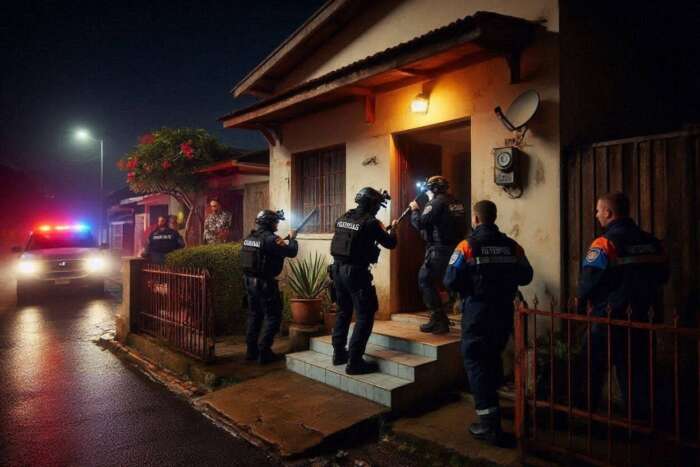
The reported capture at a private Gqeberha residence ended a seven-year search, while conflicting neighborhood descriptions, a two-year South African investigation, and continuing extradition proceedings leave important questions about the operation unanswered.
WASHINGTON, DC
The latest Robert Lee Redd Jr. arrest update places the American defendant at a private residence in Gqeberha, South Africa, where a coordinated team detained him on May 27, 2026, after investigators reportedly monitored his location while completing legal and extradition preparations.
Redd had been sought following a 2019 Bexar County indictment alleging aggravated sexual assault of a child, although those allegations remain unproven and must be distinguished carefully from the separate facts surrounding his identification, arrest, detention, and pending extradition proceedings.
The publicly available record describes an intelligence-driven residential operation rather than an airport interception, border stop, street chase, or accidental encounter, showing that authorities had apparently narrowed the search substantially before officers moved to take him into custody.
Local coverage reported that the arrest occurred at approximately three o’clock in the afternoon, reducing the likelihood that the operation depended on chance and suggesting that investigators selected a controlled moment after confirming the residence and coordinating participating units.
The most detailed local news account of Redd’s arrest identified his home as being inside the Riverdale Complex in Westbrook, while another police-based account described the arrest location more broadly as Kabega Park within the Gqeberha area.
Those descriptions should not be converted into a false claim that authorities issued contradictory official statements, because local reporting can use a residential complex, suburb, policing area, or neighboring district differently when describing the same operation.
What can be stated confidently is that officers found Redd at the home where he was reportedly living in the western Gqeberha area, rather than discovering him while he was attempting another international journey or presenting documents at a formal checkpoint.
Where the arrest reportedly occurred
South African reporting says Redd was arrested at his home in the Riverdale Complex in Westbrook on Wednesday, May 27, 2026, at approximately 15:00, following an operation involving several police and international coordination units.
The location is important because it shows that the final stage of the search centered on an established residence, allowing investigators to plan around a known property instead of confronting the unpredictable risks associated with a moving vehicle, crowded terminal, or public venue.
A separate report quoting a South African Police Service spokesperson said the suspect was arrested at his home in Kabega Park, creating a minor geographic variation that should be acknowledged without exaggerating its significance or assuming that one account necessarily invalidates the other.
Gqeberha contains closely connected suburbs, residential developments, and police service areas, so the safest publication language identifies the Westbrook home and Riverdale Complex where it was repeatedly reported, while recognizing that authorities also used the broader Kabega Park description.
No reliable public report reviewed for this article says officers captured Redd inside an airport, at a land border, on a vessel, inside a diplomatic facility, or while using an allegedly fraudulent passport or another person’s identity.
That absence matters because dramatic retellings can easily transform a carefully coordinated home arrest into a fictional last-minute escape attempt, even when the available record supports a quieter operation built around surveillance, legal preparation, and a fixed residential address.
Reports described the property as Redd’s home, indicating that investigators were not merely acting on a temporary hotel registration or an uncertain sighting but had connected him with a place where he could be approached under South African authority.
The residential setting also helps explain why local investigators remained central throughout the operation, because they understood the surrounding area, available access routes, community conditions, and domestic legal requirements governing entry, arrest, evidence preservation, and immediate court presentation.
Authorities have not published a detailed tactical account describing how many officers approached the residence, whether occupants were present, what time surveillance began, or precisely how officers confirmed Redd was inside before initiating the arrest.
Withholding those particulars is normal after an international fugitive operation, because agencies frequently protect investigative methods, cooperating sources, officer-safety information, and evidence that may become relevant during extradition litigation or later criminal proceedings.
The public record also does not establish whether the residence was owned, leased, shared with relatives, or connected to Redd through immigration records, utility accounts, marriage documentation, neighborhood information, or another administrative source.
Reporting should therefore avoid claiming that one specific document exposed him unless investigators or authenticated court materials disclose that evidence, because several ordinary records may have contributed gradually to the eventual location assessment.
Although the home address ended the physical search, it did not end the legal case, since South African authorities still had to bring Redd before a magistrate, justify continued detention, and process the American request through domestic extradition procedures.
The residence is consequently best understood as the place where the manhunt’s location phase concluded, not the place where the Texas accusations were adjudicated or where South African courts made any final decision concerning surrender.
How law enforcement reportedly identified the fugitive
Public reporting says the United States Embassy in Cape Town contacted detectives in the Nelson Mandela Bay area during 2024 and requested assistance locating Redd, providing the clearest documented transition from an American fugitive inquiry into a targeted South African investigation.
The same reports say Redd came onto American authorities’ radar after marrying a South African citizen, although they do not reveal whether the marriage itself generated the decisive record or merely helped investigators confirm information obtained through another source.
Marriage registrations can create durable administrative links involving names, dates, addresses, immigration applications, witnesses, and family connections, but responsible reporting cannot assume investigators accessed or relied upon any particular record without official confirmation.
South African detectives reportedly traced Redd to Gqeberha after the embassy request, beginning what police and local media described as a two-year investigation involving close monitoring while extradition documentation and arrest applications were completed.
That sequence indicates investigators apparently knew substantially more than they released publicly, because maintaining observation for an extended period generally requires repeated confirmation that the person at the residence matches the individual named in the foreign warrant.
Identity confirmation in international cases can involve photographs, fingerprints, passport details, birth information, family relationships, travel records, and other corroborating material, although authorities have not disclosed which combination was used specifically in Redd’s case.
The United States Marshals Service international operations program explains how American authorities coordinate transnational fugitive investigations and lawful returns with foreign partners, but its general procedures should not be mistaken for a detailed account of every step taken in Gqeberha.
Later court reporting said a United States marshal was connected with events surrounding the arrest, while other accounts identified Interpol and South African units, showing that the operation involved overlapping agencies whose precise responsibilities have not been fully itemized publicly.
The arrest team was reported to include the Nelson Mandela Bay District Detective Task Team, Crime Intelligence, Interpol, and the Nelson Mandela Bay Crime Combating Unit, with local leadership named in early accounts of the operation.
Those units supplied capabilities that an embassy could not exercise independently, because American diplomatic officials may share information and facilitate cooperation but cannot enter a South African residence or detain a person without lawful local authority.
The reported two-year period also demonstrates that identifying someone and arresting that person are separate milestones, particularly when an overseas warrant must be supported by documentation capable of satisfying the receiving country’s arrest and extradition requirements.
Police said extradition papers and arrest applications had to be finalized before the operation proceeded, suggesting that investigators prioritized an arrest that could withstand immediate court scrutiny rather than acting prematurely on intelligence alone.
No verified public source says Redd possessed counterfeit identification, used an officially registered alias, altered biometric information, or obtained South African status through a fabricated personal history, despite speculation that can accompany any lengthy international search.
The Amicus International Consulting analysis of international fugitive psychology describes how wanted people may establish ordinary routines and social relationships abroad, but general behavioral patterns cannot prove what documents Redd used or how he understood his own circumstances.
Available reports support the narrower conclusion that he built a residential life in South Africa and married a South African citizen, while investigators connected that life to the American defendant named in the active Texas case.
That distinction prevents the phrase identification from being confused with exposure of a false identity, because authorities may identify a fugitive living under an authentic name and lawful documents just as readily as someone using fraudulent credentials.
The exact investigative turning point remains undisclosed, and future extradition filings may reveal additional details concerning photographs, fingerprints, travel documents, marriage records, immigration information, or communications used to establish identity and confirm the reported location.
Until those materials become public, the strongest factual account is that the embassy requested assistance, South African detectives traced Redd to Gqeberha, authorities monitored him during a prolonged legal-preparation period, and a coordinated team arrested him at the reported residence.
What authorities said after custody
After the arrest, police spokesperson Brigadier Nobuntu Gantana confirmed that an intelligence-driven operation had taken place and said Redd would be extradited to the United States to face the allegations pending against him there.
That statement expressed the authorities’ intended direction, but extradition was not completed automatically, because South African courts and officials still had to examine detention, documentation, legal compliance, defense challenges, and any available review procedures before surrender.
Redd appeared in the Gqeberha Magistrate’s Court on May 29 and was ordered to remain at St Albans Correctional Center while the extradition process developed, moving the case from investigative control into a court-supervised custody phase.
Prosecutors opposed immediate release and treated the long period outside the United States as relevant to flight-risk concerns, while the defense began requesting documents, consultation access, and information about the legal basis for the arrest and search.
During a June 3 appearance, Redd alleged through his attorney that officers assaulted him during the arrest, including claims that he was kicked, thrown down, and stomped upon while being taken into custody.
Those allegations were presented by the defense and should not be stated as established fact, because the publicly available reports did not identify a completed independent investigation or judicial ruling confirming responsibility for the alleged conduct.
The defense said a United States marshal had witnessed relevant events and could support Redd’s account, while court reporting also indicated that he received attention from a nurse and pain medication after entering detention.
Authorities did not publicly concede the assault allegation in the available coverage, and the dispute became one of several procedural issues discussed alongside prison conditions, family visitation, access to counsel, and extradition preparation.
Redd remained in custody while his legal representative sought copies of the arrest warrant, search-and-seizure warrant, supporting affidavit, and related documents that the defense considered necessary to evaluate the operation and prepare a bail application.
By June 17, the court had scheduled a formal bail effort for July 7, while reporting that the American request, South African detention, and document exchange were still unfinished parts of the broader extradition proceeding.
On July 7, the anticipated bail hearing was postponed after defense counsel received extradition documents from American and South African authorities too late to review them adequately before the scheduled appearance in the Gqeberha court.
That postponement did not grant bail, deny bail, authorize extradition, or decide the Texas charges, because it preserved meaningful preparation time while leaving Redd detained and the principal legal questions entirely unresolved.
The most recent public update available before publication therefore places Redd at St Albans Correctional Center, no longer missing from authorities but still contesting custody and potential transfer through the South African judicial process.
The Amicus International Consulting overview of extradition proceedings explains why an overseas arrest begins a separate legal sequence, since the requested country must evaluate identity, documentation, treaty requirements, and domestic safeguards before allowing physical surrender.
If extradition is authorized after hearings and any review procedures, American officers would coordinate the transfer so Redd could appear before the Texas court responsible for the indictment and receive the procedural protections attached to the unresolved prosecution.
If surrender is delayed or challenged successfully, that result would affect when or whether he returns to Texas without independently proving innocence, just as authorization would permit prosecution to continue without establishing guilt.
The strongest arrest update is consequently precise but limited, because Redd was found at a reported Westbrook residence, identified through a two-year international and local investigation, detained during a coordinated operation, and placed into continuing South African extradition proceedings.
Questions remain concerning the exact record that produced the location lead, the complete legal authority used at the residence, the disputed treatment during arrest, and the timetable for future bail or extradition decisions.
Those unanswered issues do not erase the confirmed sequence, but they require journalists to distinguish police statements, defense allegations, court developments, and unverified speculation rather than blending every claim into one definitive narrative.
For readers following the case, future updates should be evaluated according to the procedural issue actually decided, whether involving bail, document sufficiency, extradition eligibility, appeal, custody transfer, or eventual criminal proceedings in Texas.
The arrest at the Gqeberha home was a major step in locating Redd, yet it remains only an intermediate event within a legal process that has not determined the underlying allegations or completed his return.
The case ultimately shows that international fugitives are often found through patient administrative and investigative work rather than dramatic chases, while lawful custody afterward depends on courts examining the evidence and authority supporting every cross-border step.