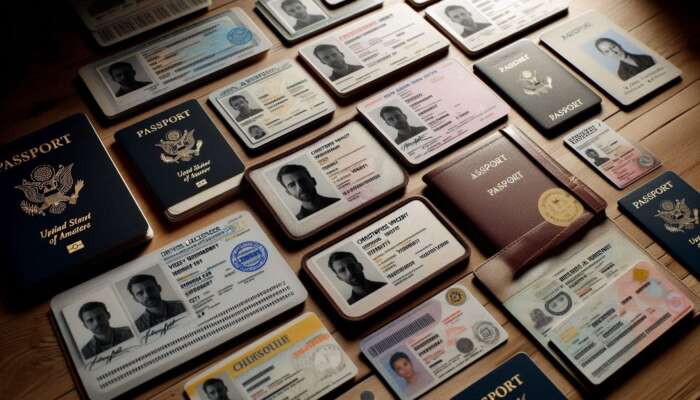
Sanctions records, passport data, and a digital trail under the name Christopher Vincent reveal how layered document identities can slow attribution, frustrate compliance systems, and help a transnational criminal network stay administratively slippery even when it is already under intense international scrutiny.
WASHINGTON, DC.
For years, the Kinahan story has been told through murders, narcotics routes, boxing influence, sanctions pressure, and Dubai luxury, yet one of the most revealing parts of the saga is quieter and more bureaucratic, because modern fugitives often survive longest not by disappearing entirely, but by multiplying the official details attached to who they appear to be.
The identity record is where the paper strategy becomes visible.
That is what makes the identity record around Christy Kinahan Sr. so important: it suggests a world in which names, birthplaces, passport numbers, and nationality markers are not simply biographical facts but operational tools that can create enough friction to complicate enforcement across borders.
When law enforcement tries to track a highly mobile suspect through aviation systems, hotel registrations, banking screens, visa controls, corporate records, and property databases, even small inconsistencies can matter enormously, because every mismatch delays certainty and forces officials to spend extra time proving that several data points belong to the same person.
The clearest public example of that problem appears in the OFAC sanctions record for Christopher Vincent Kinahan, which lists one Irish passport and four United Kingdom passports, and records multiple dates of birth and multiple birthplaces, including Cabra, Dublin, London, and Perivale in Middlesex.
That record matters immediately because it corrects one of the most repeated simplifications in public retellings, namely the idea that Christopher Vincent was merely a random alias, when in fact those are Christy Kinahan Sr.’s first and middle names in the sanctions system itself.
The same sanctions material also lists Christopher O’Brien as an alias, which means the public record does not describe a single second identity but rather a broader paper environment in which names, national markers, and official descriptors appear layered in ways that increase administrative complexity.
Administrative friction is often more useful than perfect invisibility.
That complexity is not interesting only because it sounds cinematic, and it should not be treated as trivia about a famous fugitive family, because document inconsistency is one of the most practical tools available to transnational criminal actors who rely on movement, delay, ambiguity, and bureaucratic fragmentation.
A border officer, sanctions compliance analyst, bank employee, airline staff member, or real-estate due diligence team does not operate within gangland mythology but within a rules-based system that depends on accurate matching of names, dates, passport numbers, and locations.
Once a person can appear in several slightly different official forms, or once genuine and allegedly false identity markers begin to overlap around the same individual, the burden on the system becomes much heavier, because investigators must rebuild certainty from fragments rather than from a single clean identity chain.
That is why the phrase “secondary passports” needs to be handled carefully in this context: the strongest public record does not prove that every document associated with Christy Kinahan Sr. was acquired or used in exactly the same way, yet it clearly shows a profile of unusually layered official identifiers.
The operational value of that kind of document layering is often misunderstood because people imagine false identity mainly as a Hollywood trick that makes a person untraceable, when in reality, the more useful effect is often slower, duller, and far more durable than instant invisibility.
A second passport, an alternate birthplace, a different naming format, or a variation in nationality description need not defeat the system permanently to be useful, because delaying identification for hours, days, or weeks can protect assets, smooth travel, frustrate warrants, and complicate service-provider screening.
Cross-border systems break down when one person generates several paper versions of himself.
That administrative friction becomes especially valuable when the subject is internationally mobile, because every extra verification step multiplies across airports, banks, telecom systems, hotel desks, corporate registries, and property transactions, creating enough confusion to blur the paper trail behind a person already trying to stay ahead of enforcement pressure.
The Kinahan case is therefore instructive because it shows how identity management can function not as a side note to organized crime, but as part of the infrastructure that makes large criminal enterprises more resilient in the first place.
That deeper significance became clearer when the Irish Independent reported a digital trail of Google reviews linked to Christy Kinahan Sr., describing how a profile using the name Christopher Vincent appeared to post ratings, images, and remarks tied to luxury hotels, restaurants, and travel destinations over several years.
The great irony in that reporting was not merely that an internationally exposed figure seemed to leave public traces online, but that the traces appeared under a name that was neither purely invented nor neatly identical to the most publicly notorious version of his identity.
That is exactly what makes the story so revealing, because it suggests a world in which layered identity records are not only used for formal travel or documentation purposes but can also provide enough psychological comfort that a target feels able to live semi-openly within a permissive environment.
The digital trail shows how document layering can change both behavior and paperwork.
The broader Sunday Times and Bellingcat work, as reflected in accessible reporting, suggested that the Google Maps profile had posted hundreds of reviews and photographs between 2019 and 2023, documenting a lifestyle built around premium venues, international travel, and the sort of affluent normality that makes danger look distant even when it is not.
That public digital trail should not be exaggerated into proof of every movement or every document used, yet it matters greatly because it shows how fragmented identity signals can coexist with a seemingly casual life, one in which the user does not behave like an invisible fugitive so much as a protected traveler.
In practical enforcement terms, that combination is dangerous because it produces a target who is not vanishing from the modern world, but moving through it in a way that keeps recognition slower and harder than it should be, especially across multiple jurisdictions with imperfect coordination.
The old fantasy of one perfect false passport is therefore less useful than many people think, because the more modern and more durable model appears to involve a portfolio of overlapping identifiers, some formal and some informal, that together create enough confusion to slow attribution without necessarily severing every link to the real person.
That is one reason the official American language from 2022 remains so important, because the U.S. Treasury sanctions announcement on the Kinahan Organized Crime Group did not treat identity manipulation as a quirky side habit, and instead said Christy Kinahan had registered companies under aliases or abbreviations of his name and had been known to use false identity documents.
The identity issue was part of the organization, not just part of the man.
That phrasing places the identity issue directly within the operational life of the organization rather than outside it, suggesting that the paper complexity surrounding the Kinahans was not merely a personal eccentricity but part of the machinery that allowed the wider network to move money, assets, people, and authority across borders.
That distinction matters because secondary identities become strategically powerful only when they are integrated into the larger business of organized crime, allowing a network to open accounts, acquire property, register companies, organize logistics, and preserve distance between the visible paperwork and the real decision-maker.
In that sense, shadow identities function less like masks and more like adapters, because they help a criminal structure plug itself into formal systems of banking, travel, hospitality, telecoms, and property while making it harder for those systems to identify the same underlying person quickly and conclusively.
It also helps explain why sanctions officers and financial compliance teams focus so intensely on aliases, passport numbers, birthplaces, and spelling variants: a serious transnational target is rarely caught by a single dramatic clue and is more often reconstructed from many small, consistent matches that withstand scrutiny.
When a sanctions profile lists multiple passports and multiple birthplaces, investigators are not simply looking at a strange biography, but at the documented shape of an identity architecture that could have facilitated movement and confusion across many years of international activity.
Foreign residence makes a layered identity profile more useful and more dangerous.
That architecture becomes even more useful when combined with a jurisdictional environment that offers wealth, privacy, and legal distance, because document complexity works best when it sits within a broader strategy that includes foreign residence, access to premium services, and the ability to appear established rather than hunted.
This is why the Google review episode remains more than an amusing footnote: it shows how the psychology of protection can set in around a person operating amid fragmented identity signals, especially when distance and lifestyle make the system seem slow or too divided to catch up quickly.
A man who feels sufficiently buffered by aliases, passport variations, foreign geography, and institutional friction may no longer behave like a classic fugitive who leaves no trace, and may instead behave like a confident global traveler whose administrative ambiguity seems sufficient to absorb ordinary exposure.
That apparent confidence is exactly what makes shadow identities so useful, because they do not merely change what authorities know, but also change how the target calculates risk, often encouraging more movement, more spending, more property activity, and more visible habits than would otherwise feel safe.
For law enforcement, however, the deeper challenge is that identity management sits near the center of every major transnational criminal case, because the real fight is rarely only about locating a person physically and is far more often about collapsing the wall between names, passports, companies, travel records, digital traces, and command responsibility.
The state’s real task is proving that every paper trail leads back to one accountable person.
In other words, the job is not simply to find Christy Kinahan Sr. or any other high-value target in one place at one moment, but to prove that several apparently different paper trails, digital behaviors, and document identities all point back to the same legally accountable human being.
That is one reason international legal pressure eventually becomes so significant in cases like this, because a multilayered identity system can buy time and create confusion, yet it becomes much weaker once several governments begin pooling records, aligning aliases, and matching sanctions data against property, financial, and travel evidence.
For readers trying to understand how that process works once it leaves the tabloid stage and enters real legal terrain, this overview of extradition risk and cross-border surrender mechanics helps explain why warrants, identity records, treaty relationships, and procedural trust matter far more than the mythology surrounding famous fugitives.
The same broader pattern appears in this broader analysis of shrinking safe havens and international pressure on mobility, where the crucial lesson is that multiple passports, layered names, and fragmented official records may delay accountability for years without guaranteeing that the system can eventually reconstruct the full identity picture.
That is the point many readers miss when they hear about aliases and secondary passports, because the real criminal benefit is often not permanent invisibility, but the ability to accumulate enough delay, enough doubt, and enough bureaucratic friction to keep living, traveling, investing, and transacting while the state is still trying to prove who exactly stands behind the paper.
The real advantage comes from forcing the system to work harder and slower.
The Kinahan identity story matters not because it offers a sensational tale of one mastermind outsmarting every system forever, but because it shows how modern organized crime exploits the ordinary weaknesses of administrative life, where imperfect coordination can be nearly as useful as perfect concealment.
A hotel desk that does not connect one name variation to another, a property registry that accepts a slightly different birthplace, a sanctions screen that flags too late, or an airline system that does not resolve a document discrepancy immediately can each become small but meaningful parts of a larger protection strategy.
Once those small protections accumulate across several jurisdictions, the result can look from the outside like invisibility, when in reality it is something more mundane and more troubling, namely a long-running success at forcing the state to work harder, slower, and less cleanly than it otherwise should.
That is why the shadow-identity story around the Kinahans is not mainly about one clever alias or one stray British passport, but about the modern criminal value of document complexity itself, because once a person can appear in several slightly different official forms, law enforcement is forced to spend precious time proving that every shadow still belongs to the same man standing behind it.
And in the world of transnational organized crime, where movement, money, and time are often the most valuable assets of all, that kind of delay can be worth almost as much as secrecy itself.