The framework sets up to $1.7 billion in U.S. support for 2026–2030. Uganda pledges more than $500 million in added domestic health spending.
What The America First Global Health Deal Covers
The agreement lists priority programs. It targets HIV/AIDS, tuberculosis, malaria, maternal and child health, and polio eradication.
It also backs global health security, disease surveillance, and emergency preparedness. The text links the work to stopping outbreaks before they spread internationally.
Cost Shift, Payroll Transition, and Data Systems
The MOU sets a glide path for procurement. It calls for a gradual transition of many commodities from U.S. purchasing to Uganda’s systems.
It also maps U.S.-funded frontline health workers to roles Uganda can carry on its own payroll. The plan aims to shift those roles over the five-year term.
On technology, the framework points to major investment in data and disease surveillance. It ties that work to electronic medical records, integration, and interoperability across national systems.
The agreement also includes support for faith-based healthcare providers. The text flags performance-based mechanisms, primary care grants, and digitization support.

What Officials Said
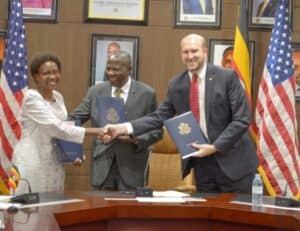
U.S. Ambassador William W. Popp said, “This agreement represents a significant commitment by the United States and Uganda to co-invest in our shared global health priorities.”
Uganda’s Finance Minister Matia Kasaija said the collaboration “will yield not only disease-specific outcomes but also significant improvements in national systems, institutions, and workforce capacity.”
America First global health deal: The MOU frames the funding around co-investment, measurable performance, and a transition toward Ugandan financial responsibility.