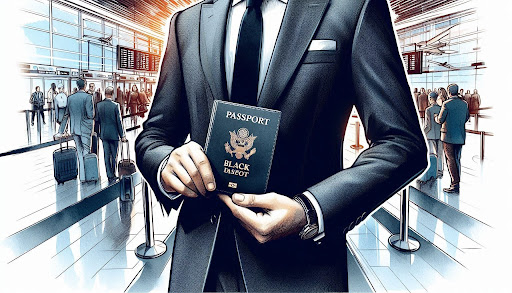
A comparison of diplomatic passports and standard passports, explaining how they differ on legal status, government purpose, practical privileges, and the real limitations that make the black passport far less magical than popular mythology suggests.
WASHINGTON, DC.
When people search for the meaning of a black passport, they are usually trying to understand whether a diplomatic passport is simply a more powerful version of an ordinary passport, but that framing misses the real point: the two documents serve fundamentally different legal and institutional purposes within the international system. An ordinary passport is the standard travel document that proves citizenship and identity for civilian movement across borders, while a diplomatic passport is a state-issued credential tied to official representation, government duty, and a narrowly defined category of travel that exists because diplomacy still requires protected and recognizable channels between states.
That difference matters immediately, because the black passport is not a luxury upgrade for important travelers, wealthy families, or politically connected people who want faster processing and fewer questions at airports around the world. As the U.S. State Department’s special issuance guidance makes clear, diplomatic and other special issuance passports are for official or diplomatic duties, are not valid for personal travel except in very limited assignment-related circumstances, and do not by themselves provide immunity, exemption from foreign law, or any shield from routine immigration scrutiny.
Ordinary passports verify identity for civilian travel, while diplomatic passports signify state representation in a specific official capacity.
The core contrast begins with status, because an ordinary passport indicates that the holder is a citizen entitled to international travel under the normal rules governing tourists, business travelers, students, family visitors, and other members of the public moving through civilian channels. A diplomatic passport, by contrast, signals to foreign authorities that the holder is traveling within a recognized government framework, meaning the trip is connected to official state business rather than private travel and that the bearer may be entitled to certain protocol-based treatment depending on status, mission, and host-country recognition.
This is why the black passport carries such heavy symbolism, because it compresses ideas of power, diplomacy, immunity, prestige, and access into a single object that looks visually distinct from the ordinary document most people carry. Yet the symbolism only makes sense because the passport points to a legal role outside the civilian lane, and without that official role, the black passport is just a misunderstood booklet rather than an all-purpose instrument of privilege.
Eligibility is one of the sharpest dividing lines, because ordinary passports are broadly available to citizens while diplomatic passports are tightly restricted to official categories.
A citizen with the required documents can usually apply for an ordinary passport as part of the normal administrative process for international travel, which is why standard passports function as the default identity document for outward movement in most democratic states. Diplomatic passports operate under the opposite logic: governments issue them only to a narrow set of diplomats, certain federal or foreign-service personnel, designated envoys, some officials with diplomatic or consular titles, and eligible family members attached to those assignments.
That restricted issuance is one of the clearest signs that the black passport is about government function rather than personal importance, because states are effectively certifying that the bearer is traveling as a recognized representative inside a diplomatic framework. An ordinary passport reflects an individual’s citizenship and right to travel, while a diplomatic passport reflects the government’s decision to send a particular person abroad under a status that other governments are expected to interpret through the rules of protocol, accreditation, and international practice.
The purpose of travel varies, and that difference changes everything, from the legal meaning of the document to how the host country interprets it at the border.
An ordinary passport is designed for personal travel in the broadest sense, which includes tourism, family visits, private business, relocation, education, and the full range of civilian movement that fills airports and border crossings every day. A diplomatic passport is issued because the state needs the bearer to travel in a recognized official capacity, which means the value of the document is inseparable from mission purpose, government assignment, and the institutional reason the passport exists in the first place.
That is why the U.S. government explicitly says a special issuance passport is not for personal travel beyond narrow assignment-related circumstances, because the state is drawing a line between public representation and private movement. In a standard civilian passport, personal travel is the point, while in a diplomatic passport, personal travel is often the exception or the misuse that governments are trying to prevent.
Privileges are real, but they are procedural and conditional rather than universal, automatic, or endlessly transferable from one situation to the next.
This is where popular imagination usually outruns legal reality, because many people assume that a diplomatic passport automatically guarantees immunity, visa-free access, fast-track entry, freedom from customs questions, or immediate deference from every border official in every country. The truth is narrower and more disciplined, because a diplomatic passport can support official travel, can sometimes shape visa treatment, and can signal that the bearer may belong to a protected category, yet the host country still looks past the cover and asks whether the traveler’s status is recognized and whether the trip genuinely falls inside official diplomatic business.
A standard passport does not usually trigger those extra protocol questions because it does not claim an official role beyond citizenship and identity, which is why the ordinary document is simpler even when it is less symbolically powerful. A diplomatic passport carries more implications, but those implications come with more conditions, more scrutiny about status, and more dependence on the larger diplomatic relationship behind the traveler.
The biggest myth is immunity, because the black passport is associated with it in public discussion, even though immunity depends on recognized status and not simply on possession of the document.
This is the dividing line that most comparison pieces get wrong, because an ordinary passport obviously does not place a traveler above local law, yet a diplomatic passport does not do that by magic either. The black passport can be part of a larger claim to diplomatic status, but the actual legal protection depends on accreditation, official function, host-country recognition, and the framework of diplomatic law rather than on the mere fact that the traveler is holding a dark-colored passport at inspection.
That distinction has surfaced in real-world litigation, including the widely cited Reuters report on the Alex Saab case, where a United States court rejected the claimed diplomatic shield after examining whether the status and credentials were actually valid in law. The lesson is straightforward because a diplomatic passport can support an argument about official role, but it cannot manufacture immunity where legal recognition, proper status, and credible accreditation are absent.
Limitations are actually much clearer on diplomatic passports than many readers expect, because governments treat them as controlled work instruments rather than as free-floating personal assets.
One reason ordinary passports feel simpler is that their limitations are mostly familiar, such as expiration, visa requirements, citizenship-based travel restrictions, and the practical burdens ordinary travelers manage every day when crossing borders. Diplomatic passports, despite their aura, come with a different kind of limitation because they are tied to office, assignment, status, and government control, which means they may need to be returned, may not be valid for private trips, and may even attract additional visa requirements in some countries rather than fewer.
That last point surprises many readers because the myth of the black passport is built on frictionless movement, while the real document often sits inside a more specialized bureaucracy that expects formal handling. An ordinary passport holder is usually just another civilian traveler, while a diplomatic passport holder may face separate paperwork, different protocols, and closer attention to whether the trip matches the official category claimed by the document.
In practical daily use, the ordinary passport offers freedom for personal movement, while the diplomatic passport offers official identity inside a more restrictive and politicized channel.
This is why the standard passport can actually feel more flexible in everyday life, because it is built for the broad spectrum of modern civilian travel and does not depend on continuing government assignment to remain meaningful. The diplomatic passport, by contrast, can be highly useful within the exact context for which it was issued, yet outside that context, it may be limited, inappropriate, or unusable in ways that ordinary travelers rarely think about when imagining the black passport as the superior document.
The comparison therefore cuts against the fantasy of a simple hierarchy in which diplomatic automatically means better, because the two documents are optimized for different worlds. A standard passport is meant for a citizen’s personal movement across borders, while a diplomatic passport is meant for a government’s managed representation through a specific person whose status is legible to other states.
The black passport carries more political meaning because it speaks for the state, while the ordinary passport speaks primarily for the traveler as a citizen.
That political dimension is one reason diplomatic passports attract so much public fascination, because they appear to place the bearer closer to the machinery of power than ordinary travel documents ever can. In reality, that closeness is exactly why the rules are tighter and why governments do not treat diplomatic passports as casual perks, since every issuance sends a message to foreign governments that the bearer is traveling inside an official relationship the sending state is prepared to stand behind.
An ordinary passport does not carry that same diplomatic weight because it is not supposed to project sovereign function beyond the traveler’s citizenship and identity. The black passport, therefore, means more symbolically, but it also means more institutionally, and that extra meaning is precisely why it comes with more restrictions, more legal nuance, and more risk of public misunderstanding.
Misuse is more damaging with diplomatic passports because the document’s credibility depends on restraint, reciprocity, and the host country’s trust that the issuing state is not abusing the category.
Governments can afford to issue millions of ordinary passports because those documents operate inside a broad civilian travel system where citizenship is the core question and personal movement is expected. Diplomatic passports live inside a narrower trust arrangement, because one government is effectively asking another government to interpret the bearer as someone moving under official authority, and that request loses force if states begin distributing black passports as favors, prestige markers, or tools of convenience for the politically connected.
This is why discussions about diplomatic status often spill into arguments about abuse, fraud, fabricated credentials, or attempts to stretch official roles beyond what the law will bear. Readers following that wider debate can see it reflected in Amicus commentary on diplomatic passports and immunity and in a separate Amicus explainer on diplomatic passports and their legal meaning, both of which underline how often public fascination with the black passport runs far ahead of the legal boundaries that make the document credible.
For most travelers, the ordinary passport is the more useful document, while the diplomatic passport is the more specialized document, and that difference is the cleanest way to compare them honestly.
A standard passport is useful because it is broad, portable, and designed for the normal realities of international life, whether that means a vacation, a family emergency, a conference, a study term abroad, or a private business meeting in another country. A diplomatic passport is useful because it is specialized, because it tells other governments that the bearer is traveling within an official public role, and because that role may engage protocol, immunity questions, visa accommodations, or diplomatic channels that ordinary travelers never enter.
Yet usefulness is not the same as superiority, because the black passport is only powerful within the structure that gives it meaning and can become awkward, limited, or legally irrelevant outside that structure. Ordinary passports travel well through the civilian world because they belong to the civilian world, while diplomatic passports travel meaningfully only through the official world they were designed to serve.
The cleanest conclusion is that diplomatic passports are different from ordinary passports, not because they are magical, but because they are institutional documents tied to state function rather than personal travel.
The black passport means the bearer may be moving as part of the state, under a role that carries symbolic and sometimes legal consequences beyond those attached to ordinary civilian travel. The ordinary passport means the traveler is moving as a private citizen through the standard global system, with all the familiar freedoms and limitations that come with ordinary border control, visa rules, and personal responsibility.
That is why diplomatic passports are different from ordinary passports in the ways that truly matter, because the distinction is about status, government purpose, conditional privileges, and very real limitations rather than about glamour or myth. For most people, the ordinary passport remains the essential tool of modern travel, while the diplomatic passport remains a narrow official instrument whose black cover signals state representation, not personal invincibility.