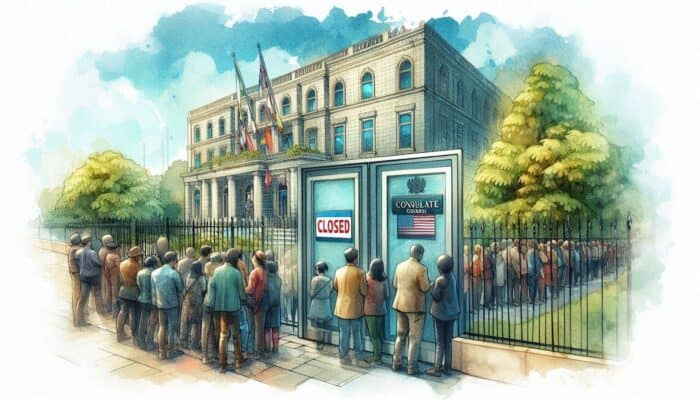
When embassies suspend operations, lawful pathways can freeze overnight, forcing third-country processing, amplifying backlogs, and turning logistics into the real immigration barrier
WASHINGTON, DC
Visa bans are often discussed as policy announcements, but many applicants experience a different kind of restriction that arrives without a headline: the sudden closure or suspension of consular operations. When an embassy pauses routine services due to conflict, political instability, or security threats, visa issuance can effectively stop even when legal eligibility rules remain unchanged. The law may still permit a visa. The infrastructure to issue it may be unavailable.
This is why consulate closures can feel more disruptive than formal bans. A formal ban usually arrives with clear public guidance, a list of affected categories, and some notice to institutions and carriers. A closure can occur abruptly, with limited information, shifting instructions, and long periods of uncertainty about where and when applicants can be processed. The result is a silent form of restriction that is harder to track and often harder to challenge. It is not a legal denial. It is an operational absence.
Closures also expose a structural truth about global mobility. Immigration is often framed as a set of rules, but it is enforced through scheduling. Interviews require time slots. Medical examinations require designated clinics. Document intake requires staff and a secure infrastructure. When those components disappear, the system can become inert, and the backlog can outlast the crisis that caused the shutdown.
A de facto ban begins when the intake pipeline stops. The visible signs are familiar to applicants.
Interviews are canceled, sometimes with little warning. Applicants receive notices that their appointments have been removed or postponed indefinitely.
Document intake pauses. Even if an application is technically complete, consular sections may stop accepting files, stop receiving passports, or stop finalizing issuance.
Casework is transferred or redirected. Applicants are told to seek processing at another post, often in a neighboring country or a regional hub.
Routine communication degrades. When a mission is operating under security constraints, response times and clarity often deteriorate, leaving applicants unsure whether to travel, rebook, or refile.
The system does not always fully stop, but partial operation can still create a de facto ban for many. A mission might continue emergency services, issue limited documents, or prioritize specific categories while suspending routine adjudication. For applicants outside those priority lanes, the practical outcome is the same as a ban. They cannot obtain an appointment. They cannot complete processing. Their timelines become open-ended.
This is why closures create a policy outcome without a policy announcement. They restrict access by removing capacity rather than by changing eligibility.
The real barrier becomes geography: Moving the interview to another country
When applicants are redirected to third-country processing, the burden shifts from legal eligibility to logistics.
Travel becomes a prerequisite. An applicant must cross a border to attend an interview, sometimes multiple times, including for biometrics, medical exams, and document pickup.
Local entry requirements become a gate. The applicant may need a visa to enter the third country where the interview will take place. That creates a circular problem. A person needs a visa interview to travel, but needs a visa to reach the interview location.
Costs rise quickly. Flights, hotels, local transportation, translation, and legal or courier costs can be decisive, especially for families and students.
Personal risk increases. Applicants may travel through unstable corridors, face detention risk at borders, or face unexpected denials of entry, stranding them mid-process.
For families, the burden compounds. A spouse and children may need to travel together. A caregiver may need to leave dependents behind. School schedules and employment constraints can make repeated trips impossible.
Third-country processing also changes the emotional stakes. What was once an administrative process managed within a person’s home country becomes a transnational ordeal, with greater uncertainty and greater exposure to sudden policy shifts across multiple jurisdictions.
Identity verification becomes harder, and scrutiny often rises
Third-country processing is not inherently suspicious, but it is a known risk indicator in many screening models because it can be associated with document shopping, fraud intermediaries, or inconsistent residence narratives. Even legitimate applicants can face heightened questioning because the location itself signals complexity.
Several verification issues tend to emerge.
Residency proof becomes central. Many consulates prefer, or require, that applicants be lawful residents of the consular district. A traveler on a short stay may be refused acceptance of the case or may be treated as a higher-risk applicant.
Document standards differ. Civil documents, police certificates, translations, and notarization requirements can vary from post to post. An applicant can find that documents accepted in one post are not accepted in another.
Medical logistics shift. Many visa categories require exams through designated physicians. A redirected applicant may need to undergo a new medical exam in the third country, which can create delays and additional costs.
Name and record consistency matter more. The more a case moves between posts, the more likely minor inconsistencies in spelling, address history, or dates become visible and consequential. A system that might tolerate a small mismatch in one location may treat it as a red flag when multiple records are compared.
For applicants, this can feel unfair. The underlying eligibility has not changed. The process becomes harder because the infrastructure is fragmented.

The ripple effects: Why Schengen and U.S. queues get worse
Consular systems are finite. When one post closes, demand does not vanish. It relocates. That relocation creates spillover effects across entire regions.
Schengen consulates experience pressure due to appointment crowding. When more applicants compete for the same slots, wait times stretch, and consulates may become more conservative in adjudication because they face higher fraud risk and higher workload.
U.S. consulates experience a similar dynamic. Visa interviews are capacity-limited. Medical exams are capacity-limited. Security screening resources are capacity-limited. When cases shift to a regional hub, the hub becomes a chokepoint, and delays can persist long after the originating post is reopened.
This is one reason closures can create years-long queues. The backlog is not merely a list of pending files. It becomes an ecosystem problem. Applicants reschedule repeatedly. Documents expire and must be reissued. New applicants enter the queue while old cases remain unresolved. Even when operations resume, the system must dig out of a hole created by months or years of lost throughput.
There is also a competition effect. When redirected demand floods a hub, it can slow processing for local residents and for other nationalities. The effect spreads outward until the entire region experiences longer timelines.
Why closures take so long to unwind: The long tail of operational recovery
Applicants often assume that once a crisis ends, consular processing returns to normal. In reality, recovery is slow because the constraints persist.
Staffing and security do not normalize instantly. A mission may reopen with reduced staffing, limited hours, and priority-only processing.
Infrastructure must be rebuilt. Secure document handling, biometric capture equipment, and internal systems require time to restore and test.
Appointment backlogs are sticky. Even with full staffing, a mission cannot instantly process months of missed interviews. It must add slots over time.
Verification becomes more conservative. After a disruption, consular sections often tighten controls to prevent fraud and ensure integrity, which can further slow processing.
Medical and support ecosystems may be degraded. Designated clinics may have limited capacity, and local service providers may be overwhelmed.
The result is a long tail. Some applicants will be processed quickly after reopening, often those in priority categories. Others will experience delays that extend far beyond the formal return of services.
How de facto bans change outcomes for families, students, and employers
De facto bans are disruptive because they undermine predictability, the foundation of planning.
Family reunification becomes time-uncertain. Children age out of eligibility categories. Spouses remain separated. Medical and caregiving needs become crisis points.
Students miss academic terms. Deferred admissions can become lost admissions. Housing and funding arrangements can collapse.
Employers lose hires or postpone start dates. Intra-company transfers and onboarding timelines are disrupted. Some companies reroute staff to third countries, creating tax and compliance complications.
These disruptions have secondary policy consequences. When legal routes freeze, people seek alternatives. That can include changing destination countries, relying more on remote work, or meeting family in third jurisdictions. In some cases, it can push people toward risky intermediaries who promise shortcuts, increasing fraud exposure and enforcement risk.
Case patterns that recur during closures
Closures tend to generate recognizable case patterns that are not always discussed publicly.
The appointment trap. Applicants keep rescheduling in a hub where slots are scarce, losing months at a time.
The document expiration loop. Police certificates, medical exams, and financial proofs frequently expire, requiring reissuance, which slows the case and increases the risk of inconsistency.
The residency mismatch. Applicants travel to a third country but cannot prove lawful residence there, leading to a refusal to accept the case or stricter scrutiny.
The family logistics collapse. A family can afford one trip but not multiple, and the process quietly fails because the required steps require repeated physical presence.
The intermediary risk. As pressure rises, intermediaries proliferate, some legitimate, some fraudulent. Consulates respond by tightening scrutiny, which can harm legitimate applicants whose files resemble templated fraud patterns.
These patterns explain why closures can be more disruptive than formal bans. A ban is a clear barrier. A closure is a moving maze.
Key questions readers ask
Is a consulate closure the same as a ban?
Not legally. Eligibility rules may remain unchanged. But the practical effect can be similar if interviews stop, document intake pauses, and issuance cannot occur.
Can applicants process in another country?
Often yes, but outcomes vary. Acceptance rules, residency expectations, local entry requirements, and wait times can change the result. Third-country processing generally increases cost and complexity.
Why do closures create years-long queues?
Because consular capacity is fixed and appointment-driven. Lost processing time creates backlogs, and those backlogs persist even after reopening due to staffing limits, security constraints, and the time required to clear accumulated demand.
Do closures affect Schengen and U.S. systems beyond the affected country?
Yes. Redirected demand concentrates in regional hubs, crowding appointment calendars and raising scrutiny because third-country processing can be treated as a risk indicator.
What can travelers do to reduce disruption?
Plan for third-country logistics early, maintain consistent identity and documentation records, anticipate document expiration cycles, and avoid last-minute travel assumptions. Where possible, align processing choices with lawful residence in the processing country and build buffer time into timelines.
Amicus International Consulting provides professional services supporting lawful third-country processing planning, documentation coordination, and compliance readiness when consular access is disrupted.
Amicus International Consulting
Email: info@amicusint.ca
Phone: 1+ (604) 200-5402
Website: www.amicusint.ca
Location: Vancouver, BC, Canada