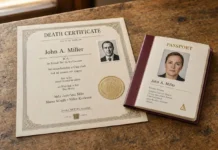
Fraud sellers are turning leaked data and forged records into a booming underground trade.
WASHINGTON, DC.
Human identity has become one of the most valuable black-market products of the digital era. In 2026, criminals are no longer treating stolen personal information as random loot from a breach or a one-time fraud opportunity. They are treating it as inventory. Names, birthdays, account credentials, document scans, phone numbers, selfies, and financial records are being bundled, sorted, resold, and reused in a dark web economy that increasingly resembles a formal supply chain.
That is what makes the current wave of identity crime so much larger than many consumers realize. The victim may think a single password was compromised or that one account was targeted. The reality is often broader. One breach can feed multiple criminal markets. One set of credentials can be sold several times. One stolen document can be used to test onboarding systems, support impersonation, build synthetic profiles, or help push stolen money through new accounts.
The most striking feature of this underground trade is not only its scale, but its specialization. One actor steals data. Another organizes it. Another tests what still works. Another supplies forged records or manipulated document images. Another runs social engineering scripts. Another handles crypto payments or cash-out. That division of labor has made identity crime more efficient, more adaptive, and more difficult to shut down.
Human identities are now treated like raw material.
The dark web business around identity fraud has matured because personal data now moves through criminal markets the way components move through legitimate commerce. A seller may advertise account credentials, partial identity kits, document templates, aged digital accounts, or access tools without ever personally speaking to the final victim. The next buyer may use those materials for credit fraud, account takeover, telecom abuse, fake account creation, or document-backed impersonation.
That shift matters because it changes the economics of the crime. A criminal no longer needs to be skilled in every stage. They do not need to steal the data themselves, forge the record themselves, and launder the money themselves. They only need access to the right marketplace and enough money to buy what they are missing.
The result is an underground identity economy built on modular services. That is one reason the problem now feels less like scattered fraud and more like industrialized deception.
Data breaches are only the first stage of the trade.
When a breach makes headlines, the public often assumes the damage ends with the disclosure. In fact, the breach is frequently just the opening act. Leaked information does not sit still. It gets packaged, enriched, cross-referenced, and resold. A compromised email address can be matched with reused passwords. A stolen phone number can be tested for account recovery abuse. A document image can be paired with other personal data to create a more convincing profile.
This is where the underground business becomes especially dangerous. Criminals do not always need a complete identity from the outset. They can assemble one from fragments. If they acquire enough matching pieces, they can create something that looks legitimate to a bank, fintech platform, telecom provider, or payment app.
In that environment, the difference between a “partial” leak and a “complete” identity theft event becomes much smaller than consumers assume. A fragment can become a profile. A profile can become an account. An account can become a payment rail.
The dark web no longer just sells data. It sells capability.
There was a time when illegal online markets were mostly discussed as places where stolen card numbers or hacked accounts changed hands. In 2026, the business is broader. The real product is capability. Buyers can obtain the pieces needed to impersonate, deceive, or pass weak verification systems without mastering the entire fraud process themselves.
That is why modern identity crime is more resilient than old-school fraud. When one marketplace is disrupted, others often absorb the demand. When one seller disappears, others provide similar tools or data sets. The goods may vary, but the structure remains the same. The market keeps moving because the services are modular and the demand remains strong.
Recent enforcement action shows authorities are starting to recognize that broader structure. In a case that underscored how globalized the fraud ecosystem has become, Reuters recently reported on sanctions tied to a Cambodia-based scam compound and a crypto marketplace accused of facilitating stolen-data trading and online fraud. The significance of that case is not only the location or the sanctions. It is the recognition that identity fraud now depends on infrastructure, facilitators, and financial channels, not just isolated scammers improvising from a laptop.
Forged records remain a critical part of the business.
The digital side of identity crime gets most of the attention, but document fraud remains central to how many of these schemes function. Criminals still need ways to support false profiles, satisfy onboarding screens, or make a stolen identity appear trustworthy enough to move through a verification process. That is where forged or altered records still matter.
Sometimes the document is fully counterfeit. Sometimes it is a manipulated image of a real credential. Sometimes, it is a fraudulently obtained genuine record used by the wrong person. In every case, the purpose is the same: to help turn scattered personal data into a believable identity narrative.
That overlap between digital fraud and document fraud is now impossible to ignore. U.S. prosecutors made that point clearly when the Justice Department described the seizure of online marketplaces that sold counterfeit passports, driver’s licenses, and other records allegedly used to bypass verification controls and gain access to online accounts. The official case summary on the Justice Department’s seizure of marketplaces selling fraudulent identity documents used in cybercrime schemes showed how fake documents are not a side business to cyber fraud. They are increasingly one of its supporting tools.
That should matter to any institution still relying too heavily on document images and static data fields as proof that a customer is real.
Victims usually see only the last stage of the crime.
One of the reasons this underground trade keeps growing is that the public tends to notice only the end result. A bank account is drained. A card is declined. A loan application appears unexpectedly. A password no longer works. But by the time the victim sees the visible damage, the criminal workflow may already be several steps deep.
Their identity may have been circulated quietly through multiple channels before the final fraud occurred. It may have been tested, repackaged, enriched with other data, and sold again. What looks like one incident to the victim can be the finished product of a much longer production process.
That delay helps the criminal market thrive. Consumers react to one event. Fraud sellers profit from repeated reuse.
Not every identity change is criminal, and that distinction matters.
In a climate of rising anxiety about identity fraud, it is also important to separate lawful identity change from illegal impersonation and forged-document crime. Those categories are often blurred in casual conversation, but they are not the same thing.
A lawful name change or legally recognized identity restructuring takes place within a formal legal framework. It is governed by rules, court procedures, or administrative processes. Criminal identity misuse, by contrast, depends on deception, fraud, and unauthorized substitution. Material published by Amicus International Consulting on lawful name change and legal identity change draws that line clearly, noting that legal identity change cannot lawfully be used to escape criminal, civil, or financial accountability.
That distinction matters because, as the dark web identity trade grows, public language around identity has become sloppier. Legal compliance and criminal impersonation are not interchangeable concepts, and treating them as if they are only makes enforcement and public understanding weaker.
The supply chain survives because many defenses are still fragmented.
The deeper problem is that fraud networks are now thinking end-to-end while many institutions still defend themselves in isolated pieces. One team focuses on onboarding. Another handles customer service. Another handles fraud operations. Another manages compliance. Other review documents. Criminals, by contrast, are often thinking about the whole sequence, from data theft to profile assembly to document support to cash-out.
That imbalance gives the underground market room to grow. It allows specialists to exploit the gaps between departments, systems, and assumptions. A profile that looks plausible at onboarding may behave suspiciously later, but the damage may already be done. A document that appears clean in a review queue may have been built from stolen information bought weeks earlier. A transfer that seems authorized may have been made possible by prior account manipulation.
In 2026, that is what the buying and selling of human identities really looks like. It is not just one scammer stealing one person’s data. It is a larger criminal business that turns real lives into modular products, then moves those products through a dark web marketplace built on repetition, specialization, and resale.
The most unsettling part is not that this trade exists. It is that it now functions with the discipline of an industry.