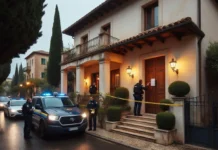
An Athens police raid exposed how forged passports, visas, residence papers, and temporary safe houses are used to move vulnerable migrants through Greece and toward other European destinations.
WASHINGTON, DC.
Greek authorities have uncovered another major document-forgery operation in Athens, exposing how criminal networks use fake passports, visas, and other identity papers to support migrant smuggling routes through one of Europe’s most important transit corridors.
The April 2026 case centered on an Athens-based network that allegedly maintained a fully equipped forgery workshop in Kallithea, operated an informal safe house in Moschato, and supplied migrants with false travel papers intended to help them leave Greece by air for other European countries.
The operation, publicly detailed by the Hellenic Police, led to the arrest of four alleged members of the organization and the detention of seven foreign nationals found inside the group’s temporary accommodation site. Police also seized 203 forged travel documents, passport covers, visa stickers, entry and exit stamps, laptops, printers, laminators, mobile phones, and equipment allegedly used to manufacture false documents.
The case illustrates why document fraud has become central to modern smuggling operations. A forged passport or visa can transform a migrant’s next step from hidden movement across land borders into attempted travel through airports, train stations, and official checkpoints, with the goal of creating the appearance of lawful passage.
For organized crime, fake papers are not a side product. They are the commercial engine of the route.
The Athens workshop was part of a wider smuggling system.
Greek investigators said the alleged network arranged for migrants to travel first to countries near Greece, then cross into Greek territory secretly on foot before continuing by bus to Athens. Once in the capital, migrants were allegedly collected by members of the group and taken to an informal lodging site while forged travel documents were prepared.
That sequence matters because it shows how the workshop was not operating in isolation. The forged papers were part of a larger package that included transport, shelter, document production, and onward travel planning.
Authorities said the group charged between 5,000 and 10,000 euros per person, a price that allegedly covered air travel, temporary accommodation, false documents, and facilitation services. From January 2026 onward, police estimated that the group had completed or was preparing at least 203 migrant transfers, with projected criminal proceeds exceeding 1 million euros.
The financial structure suggests a professionalized smuggling operation rather than a loose group of opportunists. The migrants were not simply buying counterfeit papers. They were buying a route, a place to wait, a package of documents, and access to people who claimed they could move them to another country.
That model is dangerous because it monetizes desperation. Migrants may believe they are paying for certainty, safety, or a reliable passage through Europe, when in reality they are depending on criminals whose documents may fail at the first serious inspection and whose promises can collapse without warning.
Police found the tools of an industrial document operation.
The equipment seized in the Athens raid points to a document lab designed for repeated production. Police reported finding printers, laminators, laptops, a laser machine, a stamp-printing device, passport covers, visa stickers, entry and exit stamps, and more than one hundred opened international courier envelopes.
The courier envelopes were especially important. They suggested that materials connected to passport and visa production were being received from outside Greece through international delivery channels. That detail points to a supply chain broader than a single apartment, a single printer, or a group of local suspects.
Forgery operations depend on more than visible equipment. They require templates, blank materials, images, stamps, covers, technical knowledge, customer photographs, delivery channels, payment collection, and people willing to circulate the documents.
Police also seized 18 mobile phones, a detail that may prove significant as investigators attempt to determine who supplied the materials, who ordered the documents, who arranged the transport, and whether the same network had links to other smuggling or forgery groups inside and outside Greece.
In modern document investigations, phones and computers can be more valuable than the forged papers themselves. They can reveal customers, instructions, photographs, payment trails, courier messages, location history, and communication with other criminal actors.
The forged documents were designed to open Europe’s travel system.
The documents seized in Athens included forged travel papers and materials associated with passports and visas. Similar Greek operations in recent years have uncovered forged passports, national ID cards, residence permits, driving licenses, asylum papers, Schengen visas, and other documents used to facilitate travel or legal presence in Europe.
That range matters because different documents serve different criminal purposes. A fake passport may support airport travel. A counterfeit visa may help justify entry. A forged residence permit may reduce suspicion during a police check. A fake national ID may facilitate domestic travel or administrative access. A false driving license may support vehicle rentals or local mobility.
The most sophisticated networks do not rely on one type of document. They build combinations that fit the route.
A migrant attempting to fly from Greece to another European country may need a passport, a visa or residence document, a convincing travel explanation, and sometimes supporting papers that align with the claimed identity. The goal is not only to pass one visual inspection, but to survive enough questions and checks to board the next flight.
That is why document security is such a critical part of border control. A forged document does not merely disguise a person. It gives that person a story, and that story can be used to move through systems built on trust.
Greece remains a critical pressure point for document fraud and smuggling.
Greece’s geography makes it a natural target for migrant smuggling networks. The country sits at the intersection of the eastern Mediterranean, the Balkans, Turkey, and the wider European Union, making it both an entry point and a staging ground for onward movement.
Smuggling groups exploit that position by separating the journey into stages. One group may arrange the first movement into Greece. Another may provide accommodation. Another may produce documents. Another may arrange airport departure or movement toward another European country.
The April 2026 Athens case fits that pattern. Migrants were allegedly routed into Greece, housed in Athens, and supplied with forged papers for the next stage of travel. The workshop was therefore part of a transit infrastructure, not merely a local counterfeiting site.
Earlier Greek cases show the same recurring structure. In 2025, Europol supported a Greek, German, and U.S. operation against an Athens-based network allegedly disguised as a travel agency, which investigators said distributed counterfeit documents via parcels and maintained a document-fraud operation linked to migrant smuggling. Europol described the case as a takedown of a fake document distribution hub disguised as a Greek travel agency, underscoring how front businesses can help conceal illegal paper trails.
The travel-agency disguise is significant because it shows how criminal groups can hide document fraud inside industries that already handle passports, bookings, travel questions, and international communications. What appears ordinary on the surface can become illegal once the documents are false and the movement is criminally organized.
Human trafficking and migrant smuggling can intersect through false identity.
Greek authorities described the April 2026 case as a migrant smuggling and document-forgery investigation. That distinction matters. Migrant smuggling generally involves the facilitation of unlawful movement for profit, while human trafficking involves exploitation through force, coercion, deception, abuse of vulnerability, or other forms of control.
But the two crimes can intersect. A person who begins as a smuggled migrant can become vulnerable to exploitation if debts, threats, confiscated documents, unsafe housing, or coercive control enter the process. False documents can play a role in both smuggling and trafficking because they allow criminal groups to move people, conceal identities, and separate victims from lawful protections.
The United Nations Office on Drugs and Crime has warned that forged, counterfeit, fraudulently obtained, and misused genuine documents can help traffickers and smugglers move people across borders while making detection harder. Its explanation of how document fraud is used to traffic and smuggle people reflects the growing recognition that false papers are not simply administrative tools, but instruments of control and concealment.
That is why authorities must look beyond the document itself. They need to ask who arranged it, who paid for it, who controlled the travel, who held the phone, who arranged the accommodation, and whether the person using the document was acting freely or under pressure.
In smuggling cases, the forged passport may be evidence of unlawful movement. In trafficking cases, the same document may also be evidence of exploitation.
The client network is often broader than the people found at the safe house.
The seven migrants found in the Moschato accommodation site were only the most visible clients of the alleged network at the moment of the raid. Police estimated that at least 203 transfers had been completed or were in preparation, suggesting a much wider customer base.
That customer base may include migrants who have already moved on, people waiting abroad for transport, intermediaries who refer clients, recruiters who advertise routes, and brokers who collect payments from relatives or sponsors.
Smuggling networks often operate through layered customer pipelines. A migrant may deal with one contact in the country of origin, another during transit, another in Greece, and another for documents or airport transfers. Each contact may know only part of the route, making the organization harder to dismantle.
The use of forged documents also creates a secondary market. The group may produce documents for its own clients, but similar networks sometimes sell fake papers to other criminal groups, independent smugglers, fugitives, fraudsters, or people seeking to regularize their stay through false administrative records.
That is why investigators will likely focus on the seized phones, laptops, courier materials, and document stock. Those items may reveal whether the workshop served only one smuggling pipeline or supplied a broader fake-document market.
The money behind the operation shows why fake documents remain profitable.
The alleged fee range of 5,000 to 10,000 euros per person explains why document forgery remains so attractive to organized crime. A single forged document may cost a fraction of the fee charged to the migrant, but it allows the smuggler to market the overall service as more advanced, safer, and more likely to succeed.
If police estimates are accurate, a network moving or preparing to move 203 people could generate more than 1 million euros in proceeds. That revenue can finance additional equipment, safe houses, vehicles, corrupt contacts, online advertising, and payments to couriers or document suppliers.
It can also fund expansion. A profitable smuggling network can switch routes, open additional lodging sites, recruit new intermediaries, or outsource document production to another city or country.
For law enforcement, following the money is therefore essential. Cash payments, money transfers, crypto payments, hawala-style arrangements, prepaid cards, and payments through relatives may all be used to finance smuggling and document fraud.
A document lab is the visible part of the business. The payment system is the bloodstream.
Document security is becoming an arms race.
Governments have hardened travel documents with biometric chips, machine-readable zones, secure laminates, holograms, ultraviolet features, laser engraving, microprinting, and database verification. These features make crude counterfeits easier to detect.
Criminal groups respond by improving their methods. Some invest in better equipment. Some seek stolen blanks. Some buy materials through international supply channels. Some forge supporting records rather than the main identity document. Some use genuine documents obtained through fraud. Some rely on look-alike travelers who use real passports belonging to someone else.
That evolution is why document checks cannot rely solely on a single visual inspection. Officers must compare the document, the person, the route, the supporting story, the issuing authority, the travel pattern, and any intelligence available through databases.
Amicus International Consulting has examined the broader technical struggle in its analysis of the high-tech features that make passports secure, noting how modern document design forces counterfeiters to overcome multiple layers of protection rather than simply imitating a printed page.
The problem is that not every checkpoint has the same tools. Some airports and border posts have advanced equipment and trained specialists. Others rely more heavily on visual checks, time pressure, and frontline judgment. Criminal groups search for the weakest points.
Public awareness can help reduce the market for false papers.
A public awareness campaign should focus on both risk and reality. Migrants and vulnerable travelers need to understand that paying thousands of euros for forged documents does not guarantee safe movement, legal status, or protection from arrest. It may instead expose them to exploitation, debt, detention, deportation, or abandonment by the smugglers they paid.
Businesses also need awareness. Landlords, employers, transport companies, banks, hotels, courier firms, and travel agencies can all encounter false documents or suspicious patterns before police do. Training staff to recognize red flags and report concerns can help authorities identify networks earlier.
The public message should be clear: fake documents are not shortcuts to safety. They are often entry points into criminal control.
For legitimate institutions, the lesson is equally direct. A document should not be treated as proof in isolation. It should be checked against context, behavior, records, and verification systems wherever possible.
Ongoing investigations will likely focus on suppliers and downstream users.
The raid on Athens removed one alleged workshop from operation, but the investigation is unlikely to end with the four arrests. Police will need to determine where the passport materials originated, who shipped them, who ordered the documents, who handled payments, and whether the same templates or tools appear in other cases.
The international courier envelopes may lead to foreign suppliers. The visa stickers and passport covers may reveal source channels. Mobile phones may display customer lists. The stamps and machines may connect to earlier forged documents already seized elsewhere.
Investigators will also examine whether any migrants successfully traveled using documents from the workshop and whether those documents were detected at other European airports or border points.
That is where international cooperation becomes decisive. A fake passport seized in Germany, France, Italy, or the Netherlands may match a template found in Athens. A phone number used by a document broker may appear in another investigation. A courier label may connect one workshop to a broader supply route.
Forgery networks cross borders by design. Police investigations must do the same.
The Athens raid shows why document fraud is central to Europe’s migration-security challenge.
The April 2026 Athens case is not simply a story about fake passports. It is a story about how criminal groups build systems around false identity, then sell those systems to vulnerable people seeking movement through Europe.
The workshop in Kallithea, the safe house in Moschato, the seized documents, the courier envelopes, the mobile phones, and the alleged million-euro revenue stream all point to a professionalized smuggling model in which forged papers are the key product.
For Greece, the case reinforces the need for sustained pressure on smuggling networks, stronger expertise in documentation, closer monitoring of courier channels, and deeper cooperation with European partners. For the wider EU, it shows how a single local workshop can have consequences across multiple countries if forged documents are successfully used for onward travel.
The lesson is clear. Border security does not begin at the airport gate. It begins wherever criminal groups manufacture the documents, stories, and false identities that travelers present upon arrival.
As long as forged passports, fake visas, and counterfeit identity papers remain profitable, workshops like the one uncovered in Athens will continue to appear. The challenge for authorities is to identify them earlier, disrupt their supply chains, protect vulnerable migrants from exploitation, and make false identity harder to sell as a path through Europe.