The HVAC repair vs replace Richmond homes question comes up at the worst possible time — usually when the system has just failed during a heat wave or a cold snap and the pressure to make a decision quickly works against making a good one. Understanding the factors that actually determine whether repair or replacement makes financial and practical sense before that moment arrives is what allows homeowners to make the decision calmly rather than reactively under pressure from a failed system and a house that’s becoming uncomfortable by the hour.
The Age Threshold That Changes the Calculation
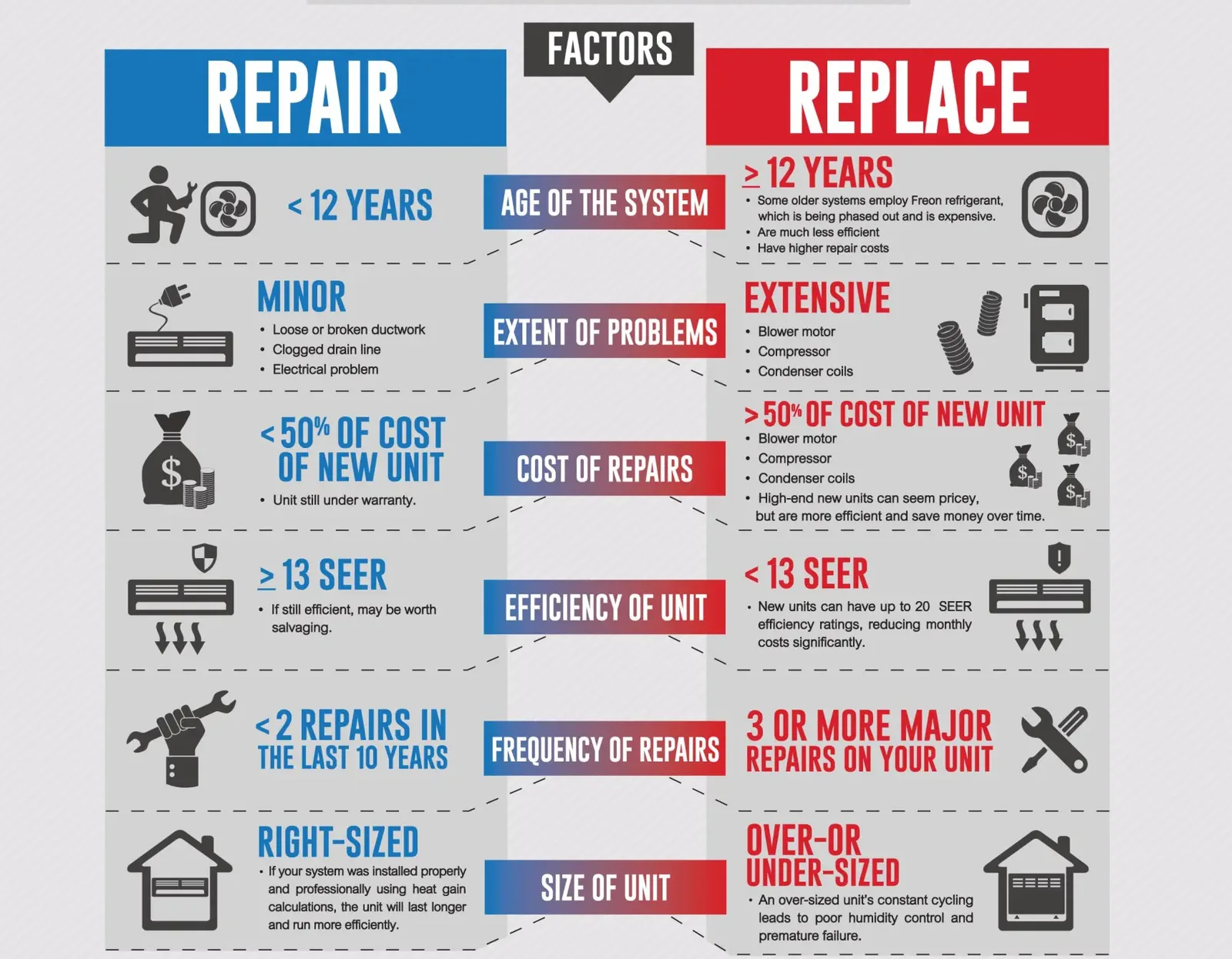
System age is the single most important factor in the repair vs replace decision because it determines the context in which every other factor gets evaluated. A repair on a five-year-old system that’s otherwise performing well is almost always the right call — the system has years of productive life ahead and the repair cost is buying continued use of an asset with real remaining value. The same repair on a system that’s seventeen years old is a different calculation entirely — the money spent may extend a system’s life by a year or two before another failure requires the same decision again.
Most furnaces and heat pumps are designed for fifteen to twenty years of useful life under normal conditions. A system within that range isn’t automatically due for replacement, but it’s approaching the phase where repair decisions need to factor in remaining useful life rather than evaluating the repair in isolation. A system past twenty years that’s requiring significant repairs has almost certainly already delivered most of its useful life and is likely operating at meaningfully reduced efficiency compared to what a modern replacement would provide.
The Five Thousand Dollar Rule
A practical heuristic that HVAC professionals use for evaluating repair vs replace decisions is multiplying the system’s age by the repair cost. If that number exceeds five thousand dollars, replacement typically makes more financial sense than repair. A ten-year-old system facing a five-hundred-dollar repair produces a product of five thousand — right at the threshold where the decision is genuinely close. The same repair on a fifteen-year-old system produces seventy-five hundred — clearly in replacement territory.
This rule isn’t perfect — it doesn’t account for the specific repair type, the system’s overall condition, or the efficiency gains available from replacement — but it provides a quick framework for situations where the decision feels arbitrary. Getting a professional HVAC inspection that assesses the overall system condition alongside the specific repair needed gives homeowners the information to apply this kind of framework with real data rather than guesswork.
Efficiency as the Factor Most Homeowners Underweight
The efficiency difference between an aging HVAC system and a modern replacement is often the most financially significant factor in the repair vs replace calculation and the one that gets the least attention in the immediate stress of a breakdown. HVAC efficiency has improved dramatically over the past decade — a system installed fifteen years ago may have a SEER rating that’s half what current minimum efficiency standards require, which translates directly into utility costs that are significantly higher than what a replacement system would produce.
Calculating the annual operating cost difference between keeping the existing system running and replacing it with a high-efficiency unit — and projecting that savings over the expected life of the replacement — often makes the financial case for replacement significantly stronger than the upfront cost comparison alone suggests. A new AC installation that costs more than a repair but saves two to three hundred dollars annually in operating costs pays for itself through those savings within a reasonable timeframe while delivering better comfort and reliability throughout.
Refrigerant Type as a Replacement Driver
For air conditioning systems specifically, the type of refrigerant the system uses is an increasingly important factor in repair vs replace decisions. Systems using R-22 refrigerant — which was the standard until it was phased out due to its environmental impact — now face a parts and refrigerant supply situation that makes repair increasingly expensive and eventually impractical as the remaining R-22 supply diminishes and prices continue rising.
A system using R-22 that requires refrigerant recharge or a compressor replacement is facing repair costs that reflect the scarcity premium on R-22 rather than the actual market cost of those repairs on a modern system. For R-22 systems with significant repair needs, replacement with a modern R-410A or R-32 system resolves both the immediate repair issue and the ongoing refrigerant supply problem simultaneously.
Comfort and Reliability as Non-Financial Factors
The financial calculation matters, but comfort and reliability deserve weight in the decision as well. A system that’s been repaired multiple times in recent years, that struggles to maintain consistent temperatures throughout the home, or that requires the household to manage around its limitations rather than simply controlling the thermostat and forgetting about it is delivering a quality-of-life outcome that doesn’t show up in the repair vs replacement cost comparison.
Working with an HVAC services provider who evaluates the full picture — age, condition, efficiency, repair history, and comfort outcomes — rather than simply quoting the immediate repair is what produces a recommendation that serves the homeowner’s actual interests rather than just the most immediate problem.