On a few acres of land, the old way of getting rid of a collapsed shed or a stack of torn-out roofing is a match or a backhoe. Pile it up, burn what burns, push the rest into a low corner and cover it with dirt. In parts of rural Louisiana, that habit has outlived the law.
Robert is one of the places where it still comes up. The unincorporated community sits in eastern Tangipahoa Parish where US 190 meets LA 445, with a signed exit on Interstate 12, about a mile east of the Tangipahoa River. Much of the land around it is acreage rather than subdivision: long gravel drives, wooded back lots, and older outbuildings that eventually come down.
When they do, the debris is governed by state rules that do not care how far the property sits from town.
What the state actually prohibits
The Louisiana Department of Environmental Quality spells out the rule in plain language. Its flyer on the proper disposal of solid waste and waste tires was revised in March 2026. It states that it is against the law in Louisiana, even on private or personal property, to burn solid waste or to dispose of solid waste or waste tires on the ground.
The definition of solid waste in that flyer is broad. It includes construction and demolition debris, household waste, tires, furniture, plastic, paints, chemicals, asphalt shingles, cardboard, and other paper products. A torn-down barn, shingles from an old roof, and furniture cleared out of an estate all fall under it.
The flyer also names the consequence. LDEQ has authority to enforce rules on open burning and unauthorized disposal, and failure to comply can result in civil or criminal fines, probation, or jail time.
The exceptions are narrower than most people assume
Part of the confusion is that some outdoor burning is legal. The excerpt of the Louisiana Administrative Code printed on the back of the LDEQ flyer lists exceptions, and most of them involve plant material rather than building material.
A private owner may burn leaves, grass, twigs, branches, and vines on their own property for noncommercial purposes in parishes with a population of 300,000 or less, as long as the owner attends the fire the whole time. Burning trees, brush, and other vegetable matter is allowed in parishes of 90,000 or less, outside city limits, under certain conditions. Land clearing burns have their own rules, including a 1,000-foot setback from other dwellings and daytime hours.
Even those land clearing burns carry a material restriction. Heavy oils, asphaltic materials, items containing natural or synthetic rubber, and other materials besides plant growth that produce unreasonable amounts of smoke may not be burned or used to start a fire.
The practical line is simple. Yard waste can sometimes be burned, depending on where the property is. Lumber, siding, roofing, insulation, carpet, mattresses, and anything else that came out of a building cannot be burned.
Why the rule exists
LDEQ ties the prohibition to what open burning releases. According to the flyer, burning household trash or tires can put sulfur dioxide, carbon monoxide, hydrogen chloride, hydrogen cyanide, phosgene, dioxin, and heavy metals into the air, soil, and water. Those pollutants can harm the person tending the fire and anyone nearby, including neighbors, children, pets, and livestock, and they can contaminate soil and groundwater.
Burying debris does not make it go away. Treated lumber, painted wood, and asphalt shingles stay in the ground, which is why the state treats disposal on the ground the same way it treats burning: both are prohibited for solid waste.
How much material is involved
Construction and demolition debris is not a small side stream. The U.S. Environmental Protection Agency’s construction and demolition debris data estimates that 600 million tons were generated in the United States in 2018, more than twice the amount of municipal solid waste generated that year.
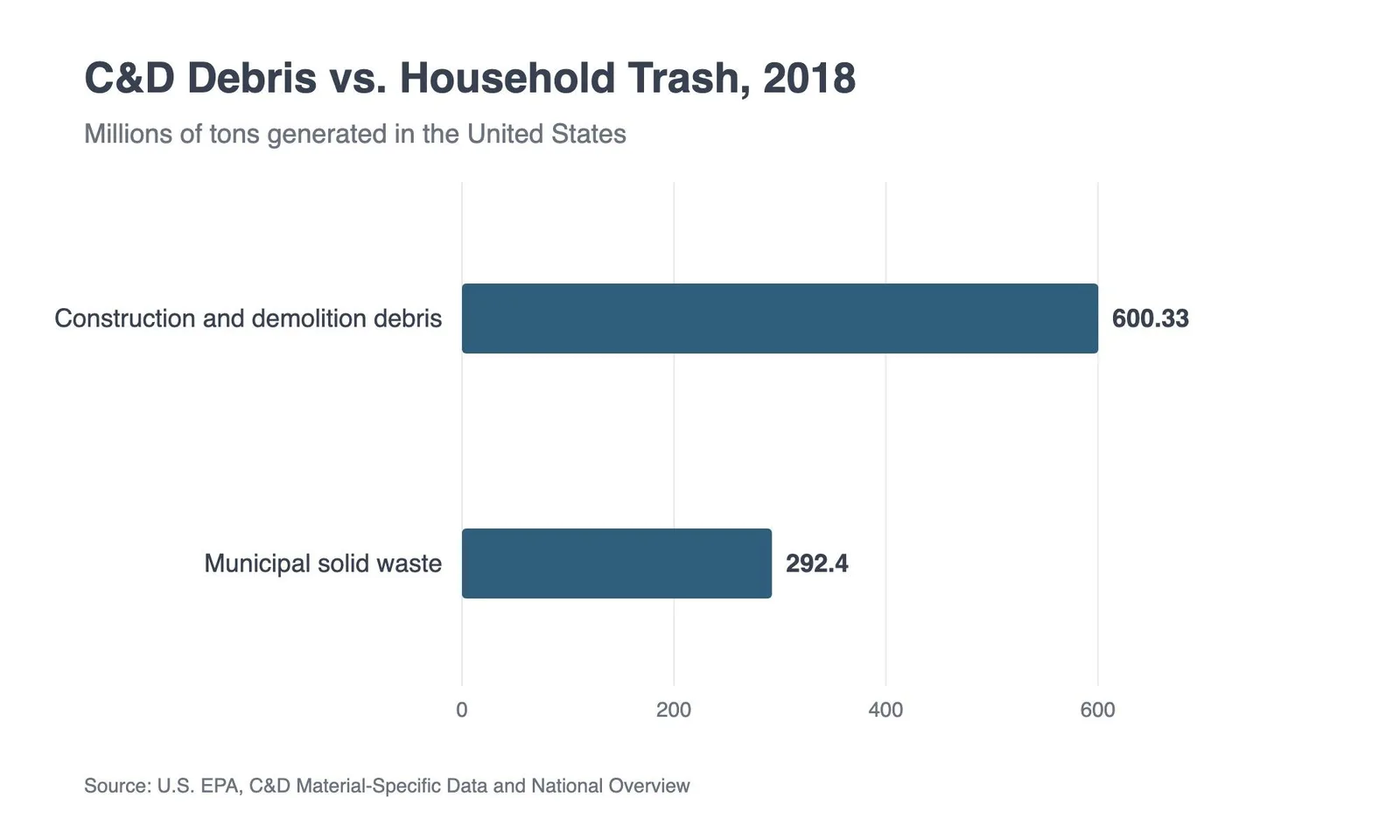
Source: U.S. EPA, Construction and Demolition Debris: Material-Specific Data, and National Overview: Facts and Figures on Materials, Wastes and Recycling.
Most of that tonnage does not end up in a landfill. EPA’s 2018 figures show about 313 million tons going to aggregate and about 132 million tons going into manufactured products. Roughly 144 million tons were landfilled. Smaller amounts went to fuel, compost and mulch, and soil amendment. Together, about three-quarters of the 2018 total was sent to a next use rather than a landfill.
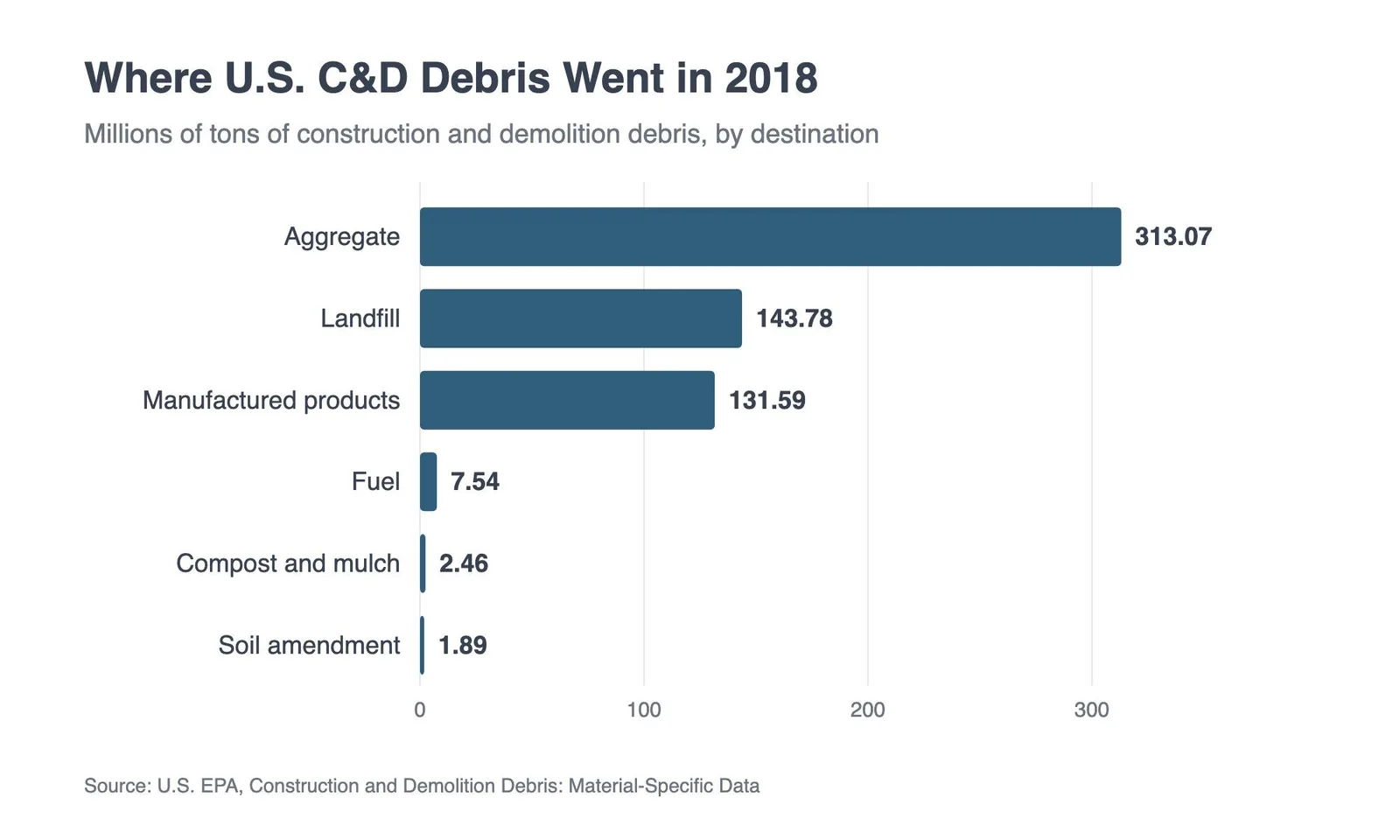
Source: U.S. EPA, Construction and Demolition Debris: Material-Specific Data.
EPA’s estimate covers buildings, roads, and bridges together. On a single rural property, the volume is far smaller, but the materials are the same ones EPA counts: wood, roofing, drywall, metal, and concrete. A debris pile that burns or gets buried on acreage near Robert is material that, handled through permitted channels, would mostly be put to another use.
What the legal routes look like
LDEQ’s flyer lists three alternatives to burning and dumping. Usable items such as furniture, tools, and electronics can be donated or sold. Household waste can be delivered to a permitted disposal facility or a state-approved collection site. Property owners can contact an authorized solid waste transporter to move material from a home or business to a permitted facility. The agency publishes lists of permitted landfills and authorized transporters on its website.
Waste tires follow their own rules. Individuals may bring no more than five waste tires a day to a waste tire collection center, and larger piles require a one-time cleanup application through LDEQ.
For a rural tear-out, the most common route is a roll-off container. A container is set on the property, the debris goes into it, and a hauler takes the full load to a permitted facility. Some materials cannot go into a standard container at all. Liquid paint, chemicals, solvents, motor oil, car batteries, propane tanks, tires, and appliances that hold refrigerant each require separate handling.
On acreage, placement matters as much as size. A loaded container is heavy, and a gravel drive, a soft pasture edge, or a slope can all affect where it can sit. Some haulers lay boards under the container to protect the surface it rests on.
The local picture
Robert is unincorporated, which means no town hall issues permits for a container in a private driveway. Parish and state rules apply, and for debris disposal, the state rule matters.
Clean Slate Dumpsters, a Hammond-based roll-off company founded by Chris Martin in May 2025, lists Robert among its service areas, about 16 miles from its yard. The company rents 15-, 20-, and 30-yard roll-off containers and lists the same items as prohibited in its containers that state rules route elsewhere, including tires, propane tanks, and refrigerant appliances.
The bottom line for rural owners
The open burn pile is a familiar sight in the countryside, and for leaves and limbs, it remains legal in many Louisiana parishes with conditions. Building material is a different category. LDEQ says burning or burying it is illegal on any property, public or private, and that penalties include fines and possible jail time.
That applies to anyone near Robert clearing an old structure, a storm-damaged outbuilding, or the accumulated contents of a family property. The safe assumption is that anything that was once part of a building leaves the property on a truck, not in smoke or under dirt.