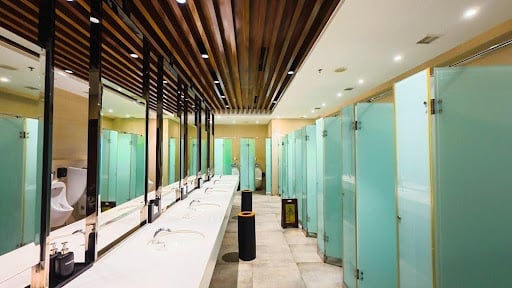
Toilet partitions are available in several mounting configurations. Each affects structure, maintenance, and, importantly, privacy. The mounting choice is one of the more consequential decisions in a restroom specification.
Specifiers often select mounting based on cost or installation ease. Privacy deserves equal weight in that decision. The style chosen shapes how enclosed each stall ultimately feels.
What Are the Common Mounting Styles?
Partitions are typically floor-mounted, ceiling-hung, or floor-to-ceiling. Floor-mounted systems anchor to the floor with overhead bracing, while ceiling-hung systems suspend from the structure above. Floor-to-ceiling designs anchor at both ends.
Each configuration carries structural and maintenance implications. Ceiling-hung systems ease floor cleaning, while floor-to-ceiling designs offer maximum rigidity. The privacy implications follow from how each closes off a stall.
How Does Mounting Influence Enclosure?
Mounting style influences how completely a stall is enclosed. Floor-to-ceiling configurations close the most sightlines by extending fully from floor to overhead. Standard-height systems leave more open space above and below.
An industry analysis of partition design notes that mounting and panel height directly affect how private a stall feels, and that no-gap restroom partitions are most achievable when enclosure is considered alongside the mounting decision. The report connects configuration choices to occupant privacy outcomes.
Floor clearance is a recurring privacy factor across styles. Lower panels reduce the visible gap beneath a stall. Mounting and panel height together determine that clearance.
What Factors Guide the Mounting Choice?
Several considerations shape which mounting style fits a project. The factors specifiers weigh include:
- Structural support available in the building
- Desired floor clearance and panel height
- Maintenance and cleaning priorities
- Durability requirements for traffic levels
- The level of privacy the project targets
Privacy belongs among these factors rather than after them. Treating it as an equal priority changes the configuration chosen. The result is a stall that feels genuinely enclosed.
How Does Durability Factor In?
Mounting style also affects long-term durability. Floor-to-ceiling and floor-anchored systems resist movement under heavy use. Stable partitions maintain their privacy fit over time.
Loose or shifting partitions widen gaps as they age. A rigid configuration preserves enclosure for the life of the installation. Durability and privacy reinforce each other.
Which Style Best Supports Privacy?
Floor-to-ceiling configurations generally support privacy best. By extending fully top to bottom, they close the gaps that other styles leave. They are a strong choice where enclosure is a priority.
That said, well-designed systems in other configurations can also perform. The key is pairing the mounting with low floor clearance and tight panel fit. Privacy is achievable across styles with the right specification.
How Does Floor Clearance Change by Style?
Floor clearance varies meaningfully between mounting configurations. Floor-to-ceiling and floor-anchored systems can be specified with minimal gaps beneath the panels. Ceiling-hung designs ease cleaning but often leave more open space below.
That clearance is one of the most visible privacy factors in a stall. A lower panel reduces the sightline beneath the door and side panels. Specifying clearance deliberately closes a gap occupants routinely notice.
What About Retrofit Versus New Construction?
Mounting choices differ between retrofit and new construction projects. New construction allows the structure to support any configuration the design calls for. Retrofits must work within the bracing and floor conditions already in place.
Privacy goals should still guide the decision in both cases. Even within retrofit constraints, panel height and clearance can be optimized. Planning for enclosure early produces a better result than treating it as an afterthought.
Mounting style is a privacy decision as much as a structural one. The configuration chosen shapes how enclosed every stall in a restroom feels.
How Does Mounting Style Affect Installation Time?
Floor-mounted systems generally install faster than floor-to-ceiling or ceiling-hung alternatives, since they involve less structural coordination with the building’s overhead or floor conditions. That speed can matter on tight renovation timelines where restrooms must stay in service between phases.
The faster installation does come with the trade-off of the reduced privacy and stability discussed earlier. Specifiers weighing a fast turnaround against long-term performance should be clear-eyed about what each mounting style sacrifices to achieve it.
Which Mounting Styles Suit Wet Environments Best?
Ceiling-hung and floor-to-ceiling systems tend to perform best in wet environments like pool facilities and locker rooms, since they minimize floor-level hardware that can corrode or trap moisture. Floor-mounted brackets are more exposed to standing water and cleaning chemicals.
Choosing a mounting style suited to the environment extends the system’s service life considerably. A mismatch between mounting style and moisture exposure is a common source of premature hardware failure.
How Do Mounting Choices Affect Future Reconfiguration?
Some mounting systems make it easier to reconfigure a restroom layout later, since panels can be relocated without extensive structural rework. This flexibility matters for facilities that anticipate remodeling, tenant turnover, or changing occupancy needs over time, since the cost of a future reconfiguration depends heavily on this early decision.
Specifiers working on buildings with an uncertain long-term use should weigh this flexibility as part of the mounting decision. The cheapest option today is not always the cheapest option across a building’s full lifespan.
For specifiers, the practical lesson is to weigh privacy alongside cost and maintenance. The mounting choice deserves that consideration from the start.