Marketplace terms spell out which lost jobs a contractor pays for anyway. Most lead budgets are built on the wrong number because of it.
By Clint Sanchez
A contractor who buys leads usually tracks one number: the price of the lead. That number is easy to find because it shows up on every statement. It is also the wrong number to manage a business by.
The figure that decides if a lead program makes money is the cost of a job actually won. That figure includes every lead that went nowhere. The clearest explanation of why it matters sits in a place few owners read closely: the refund and credit terms of the marketplaces selling those leads.
What the credit rules say
Angi Leads, whose pro program runs from HomeAdvisor’s pro site, publishes lead credit guidelines that list the situations it will not credit. The list includes a consumer who does not call back, a consumer who already found someone, a consumer who changed their mind, and a consumer who is just shopping. It also includes a plain one: you did not win the job.
The company’s wording on why is useful. It says those situations are accounted for in its lead pricing. In other words, the risk of losing the job is already built into the sale, and the contractor carries it.
That is not a hidden trick. It is stated openly, and credits do exist for other problems. But it does mean the lead is the product being sold, and the job is not. A contractor who reads the terms that way will budget differently from one who treats a lead as a job that has not started yet.
Other marketplaces draw the line elsewhere
Terms vary, so no single rule covers the whole market. Thumbtack’s Quality Commitment page says it limits the number of pros a customer can contact to five in the first four hours of a search, while noting that customers usually reach out to fewer. Customers can contact more pros after that window.
Google’s Local Services Ads run on a different model. Google’s help pages say advertisers pay for valid leads, and that a follow-up from the same customer within 15 days is not charged again. A missed call during business hours can still count as a valid lead if the caller stays on the line for more than 20 seconds.
Each of those rules is reasonable from the seller’s side. Taken together, they point to the same conclusion for the buyer. Paying for a contact and winning a customer are separate events, and the gap between them belongs to the contractor.
The number to track instead
The arithmetic takes one line. Divide the average price per lead by the close rate on those leads, and the result is the cost of each job won.
Take an assumed lead price of $60, used here only to show the math. It is not a market price, because lead costs vary too much by trade and market for one figure to mean anything. At a close rate of one in five, each won job costs $300. At one in ten, the same $60 lead costs $600 per job.
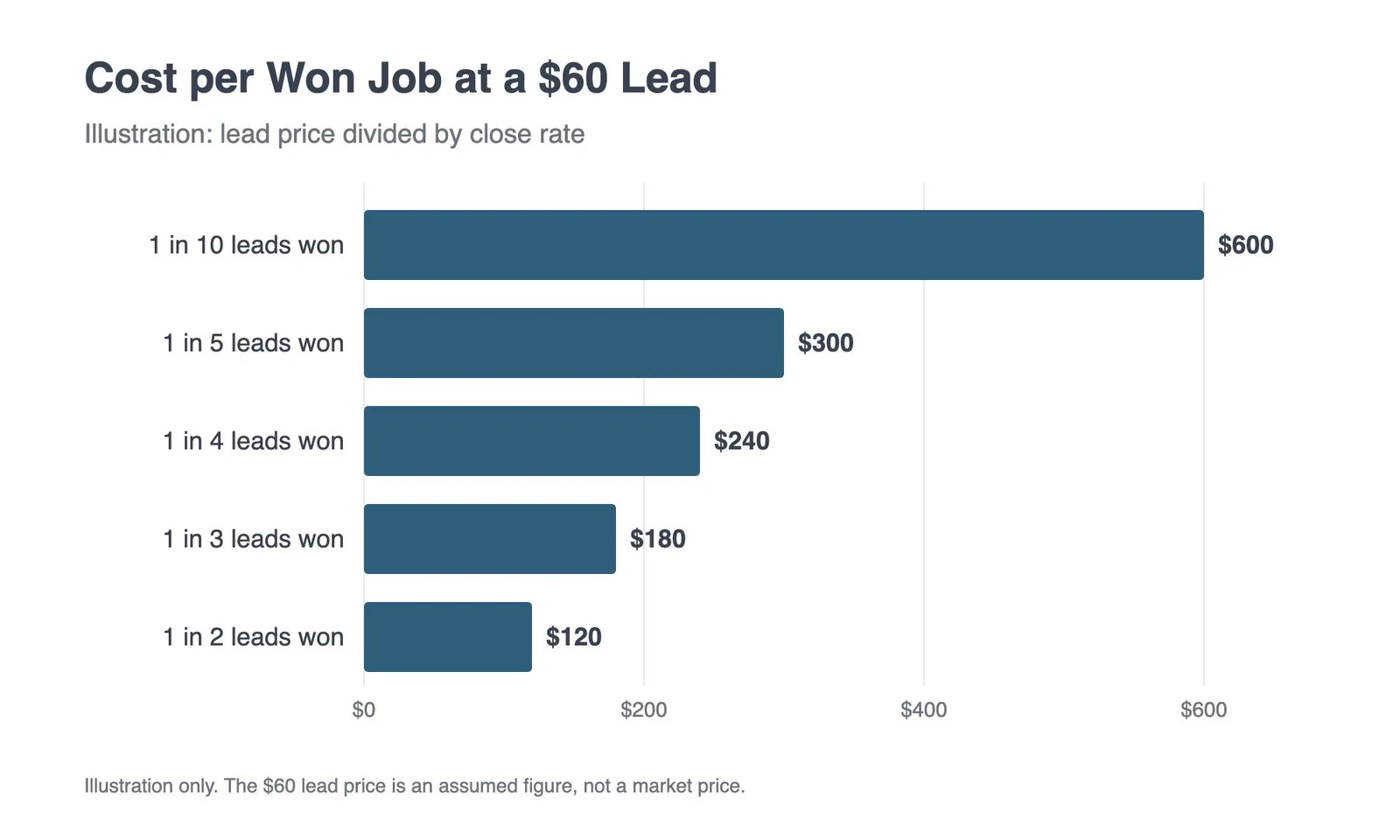
An illustration using an assumed lead price. Substitute your own numbers.
That spread is the reason close rate deserves as much attention as lead price. A contractor who negotiates a cheaper lead but closes fewer of them can end up paying more per job. Tracking every lead for 60 to 90 days, including what was paid, if the customer was reached, and if the job was won, usually answers the question better than any industry average.
Speed changes the math
Close rate is not fixed, and response time is one of the few parts of it a contractor controls. Jobber’s 2026 Home Service Trends Report, based on a survey of 1,050 home service business owners in the United States, says over 55% of customers expect a response within the hour and 28% expect an immediate reply.
Answering is the harder part for a crew on a job site. Call tracking company Invoca reported in 2024 that 27% of calls to home services businesses are not answered, and that less than 3% of callers pushed to voicemail leave a message. Those figures come from a vendor that sells call tools, so they are best read as a signal and not a precise benchmark. Still, the direction is hard to argue with.
The pattern is easy to see in a single trade. A guide on how electricians get leads without paying for every one makes the same point: a panel or generator request usually goes to more than one shop, so a slow reply can cost the job before price comes up.
What buyers check before they call
The other part of close rate is decided before the phone rings. BrightLocal’s Local Consumer Review Survey 2026 found that 97% of consumers read reviews for local businesses. It also found that 47% will not use a business with fewer than 20 reviews, and that 74% only care about reviews written in the last three months.
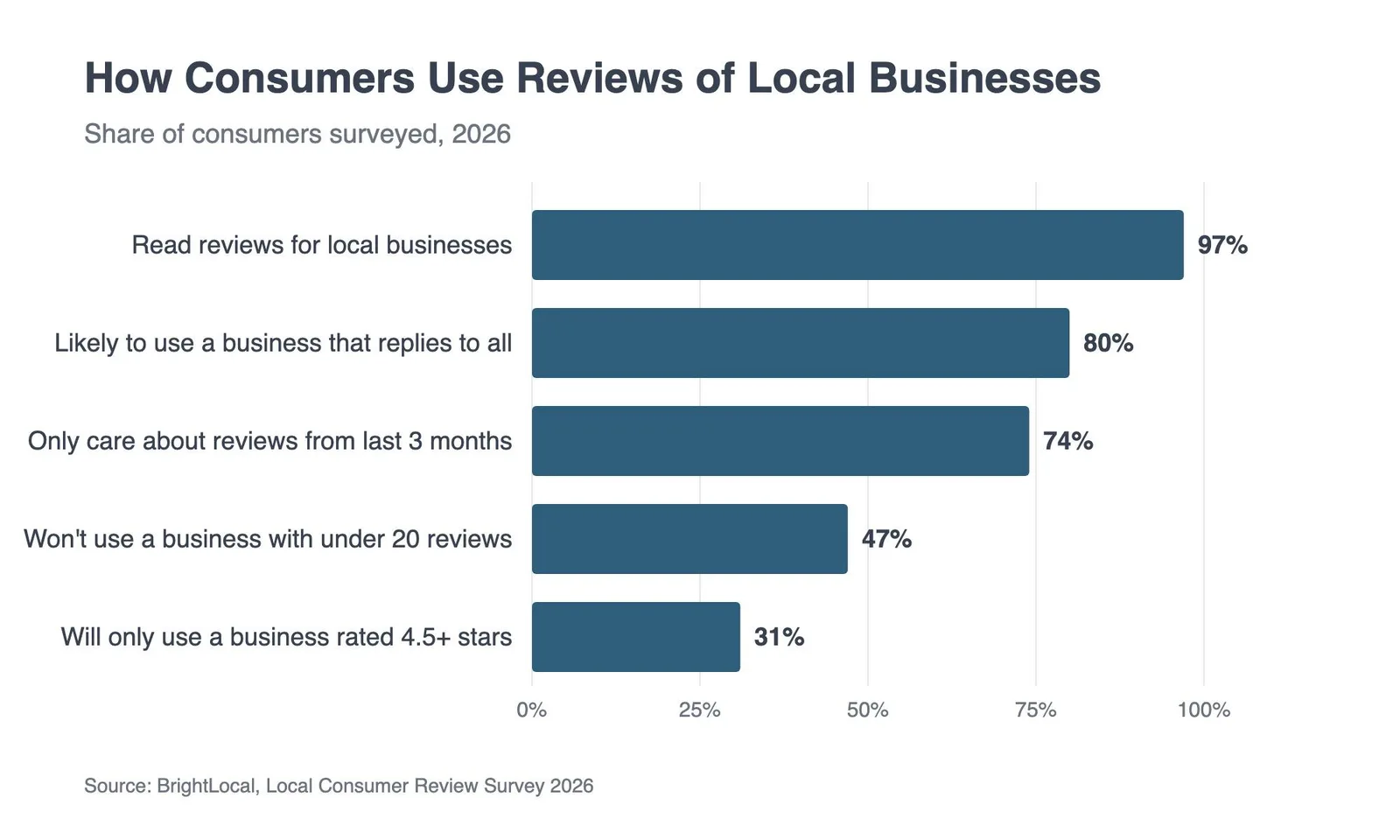
Source: BrightLocal, Local Consumer Review Survey 2026.
For a contractor buying leads, those numbers work in both directions. A strong, recent review record can lift the close rate on every lead purchased. A thin one means paying full price for a contact who may decide against the business in the first minute.
Reviews also sit outside the meter. A marketplace charges for each contact, and that charge returns the next time a customer reaches out through it. Reviews on a business’s own Google listing keep working after a marketing budget pauses.
Rented and owned channels
This is where the industry’s framing of rented and owned leads becomes practical. A rented lead is one paid for each time. An owned lead comes from something the business controls, such as a Business Profile, a website with a page for each service, a review record or a list of past customers.
Owned channels are not free, and they are not fast. They take time or money to build, and no one can promise a date when the calls begin. For a new company with no reviews and no website, buying leads can be the quickest way to get the first jobs on a calendar.
The useful comparison is not one against the other. It is the monthly cost of an owned channel measured against the cost per won job from paid leads. Owners weighing that decision can start with a breakdown of where contractor leads come from and which ones are worth buying, then run the numbers on their own trade.
A market that rewards reading the terms
Marketplace terms will keep changing, and so will prices. What is unlikely to change is the structure: a seller of contacts has little reason to carry the risk of a lost job, and the published rules say so.
The open question is how many small contractors know their own cost per won job. Public data on that figure is scarce, because the inputs sit inside each company’s records. Until better data exists, the most reliable benchmark available to any owner is the one built from their own last 90 days of leads.