The most expensive mistake in corporate value isn’t a single bad decision. It’s a slow leak that nobody diagnoses until it reaches the financial statements — at which point the pattern has been forming for years and the cost of fixing it has compounded. The $81 billion Paramount–Warner Bros. Discovery merger is a vivid illustration, but the leak itself is a general pattern, and it runs in a predictable sequence.
Start with the illustration, because it makes the stages concrete. The combined company carries roughly $80 billion in debt, serviced heavily by traditional television — a segment eroding at close to ten percent a year, with streaming not yet at the scale to replace it. Leadership plans to bridge the gap with about $6 billion in synergies over three years. The debate has fixed on whether that target is reachable. But even a flawless synergy model can’t answer the deeper question, because a synergy model measures the price of scale, not whether the combined business is aligned to keep creating value while its market moves. That’s the thing that leaks, and here’s how.
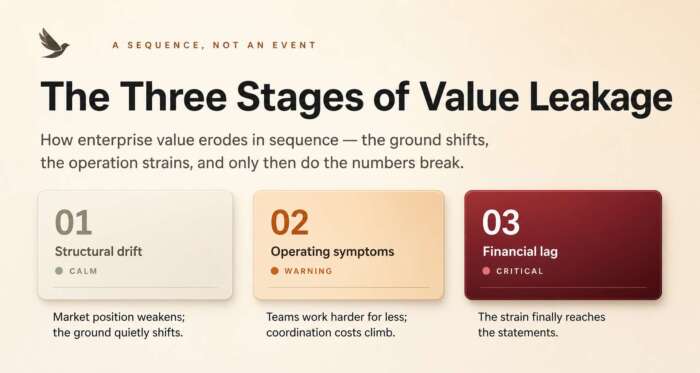
Stage one: structural drift. Market position weakens, or the ground the business stands on quietly shifts. It rarely announces itself. In media, structural drift was cord-cutting and streaming eroding the core for years before anyone treated it as a crisis. In other industries it’s a saturating channel, a changing buyer, a technology resetting the cost curve. The defining feature of stage one is that it’s happening in the structure of the business, not yet in its numbers — so anyone watching only the numbers can’t see it.
Stage two: operating symptoms. The drift starts showing up in how the organization runs. Teams work harder for less. Coordination costs climb. Cost-cutting rounds pile up until there’s nothing obvious left to trim — roughly where Warner already sat after years of austerity. Leaders often read these symptoms as execution problems and respond with more discipline, more trimming, more pressure. But the symptoms are downstream of the structural drift in stage one, and treating them as isolated performance issues just buys time while the real condition keeps compounding.
Stage three: the financial lag. Only now does the strain reach the income statement, the leverage ratio, the quarterly review — and by the time it does, the pattern has been forming for years and correction is slow and expensive. This is the stage most organizations actually react to, because it’s the first one their instruments were built to detect. Dashboards, KPI reports and quarterly reviews are genuinely useful for tracking targets you’ve already set. They are not built to diagnose the structural conditions that produce those outcomes in the first place. They tell you what happened, not why, and not what the system needs to change before the next cycle begins.
That sequencing is why the sharper question about any large bet isn’t whether the near-term math works, but whether the underlying system is aligned to create value while conditions keep shifting — a question that has to be asked at stage one, because the leverage to act cheaply disappears by stage three.
This is the diagnostic discipline that firms like Redtail Capital, a capital and advisory firm, have built their practice around: reading the structural conditions that produce financial outcomes — market position, operating capability, capital allocation — before those outcomes surface in the statements, and treating the business as one interconnected system rather than a stack of quarterly line items. The premise is simple. Once value leakage reaches the numbers, you’re managing a crisis. Caught at stage one, you’re managing a business.
The Paramount deal will be judged, for now, on a spreadsheet — and spreadsheets are honest about one thing: they record what already happened. Whether the bet becomes durable value or a durable burden will be settled earlier than that, by whether anyone read the system before the leak reached the numbers.