A wood fence in South Louisiana has a hard life. The pickets get sun and rain, but the posts sit in damp soil around the clock, in a climate that federal data ranks among the hardest on wood.
Federal research puts numbers on that. A decay index kept by the U.S. Forest Service ranks the Baton Rouge area among the highest-risk places in the country for wood left outdoors.
What the Decay Hazard Index Measures
The index was proposed in 1971 by researcher T.C. Scheffer and is now widely used to compare decay risk between U.S. locations. It uses two inputs from weather records: the average temperature for each month and the number of days that month with at least 0.01 inch of rain.
Warm months with frequent rain push the score up. A month that averages below 35 degrees Fahrenheit adds nothing, since that is the point at which decay fungi go dormant.
In 2009, the USDA Forest Products Laboratory recalculated the index for 280 locations using 1971 to 2000 weather normals. That Forest Products Laboratory report on decay hazard index values lists every score in a single table.
The report’s map sorts the country into three bands: under 35, 35 to 65, and more than 65. Higher numbers mean greater decay hazard.
Where Baton Rouge Lands
Baton Rouge scored 85.7. The average across the 228 locations the report could compare with Scheffer’s originals was 46.7, so Baton Rouge sits at nearly twice the national figure by our arithmetic.
Only 14 of the 270 locations in the lower 48 scored higher. Twelve of them are in Florida. The other two are New Orleans, at 94.7, and Mobile, Alabama, at 93.8.
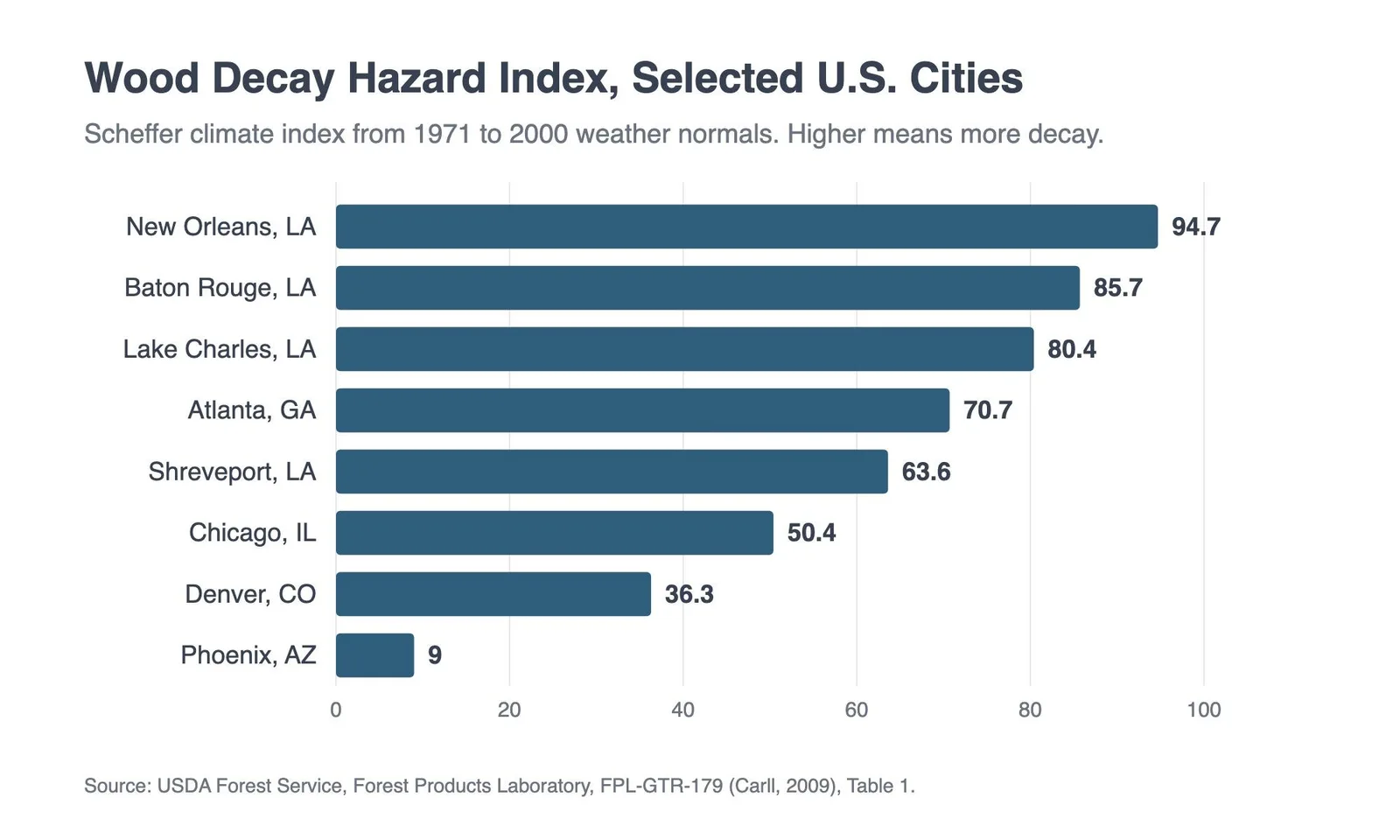
Decay hazard index for selected U.S. cities, 1971 to 2000 normals.
The rest of Louisiana is not far behind. Lake Charles scored 80.4, Alexandria 72.8, and Shreveport 63.6. For comparison, Chicago scored 50.4, Denver 36.3, and Phoenix 9.
Baton Rouge’s score was also 7.7 points higher than the value Scheffer listed for it in 1971. The report flags a change of 5 points or more as appreciable.
Rain Days Matter More Than Rain Totals
The index counts how often it rains, not how much falls. A city with frequent light showers can outscore one with fewer, heavier storms.
NOAA’s 1991 to 2020 climate normals for the Baton Rouge Ryan Airport weather station show 61.94 inches of rain a year, spread across an average of 114.1 days with measurable rain. Even the driest month by that measure, October, still averages 7.3 rain days.
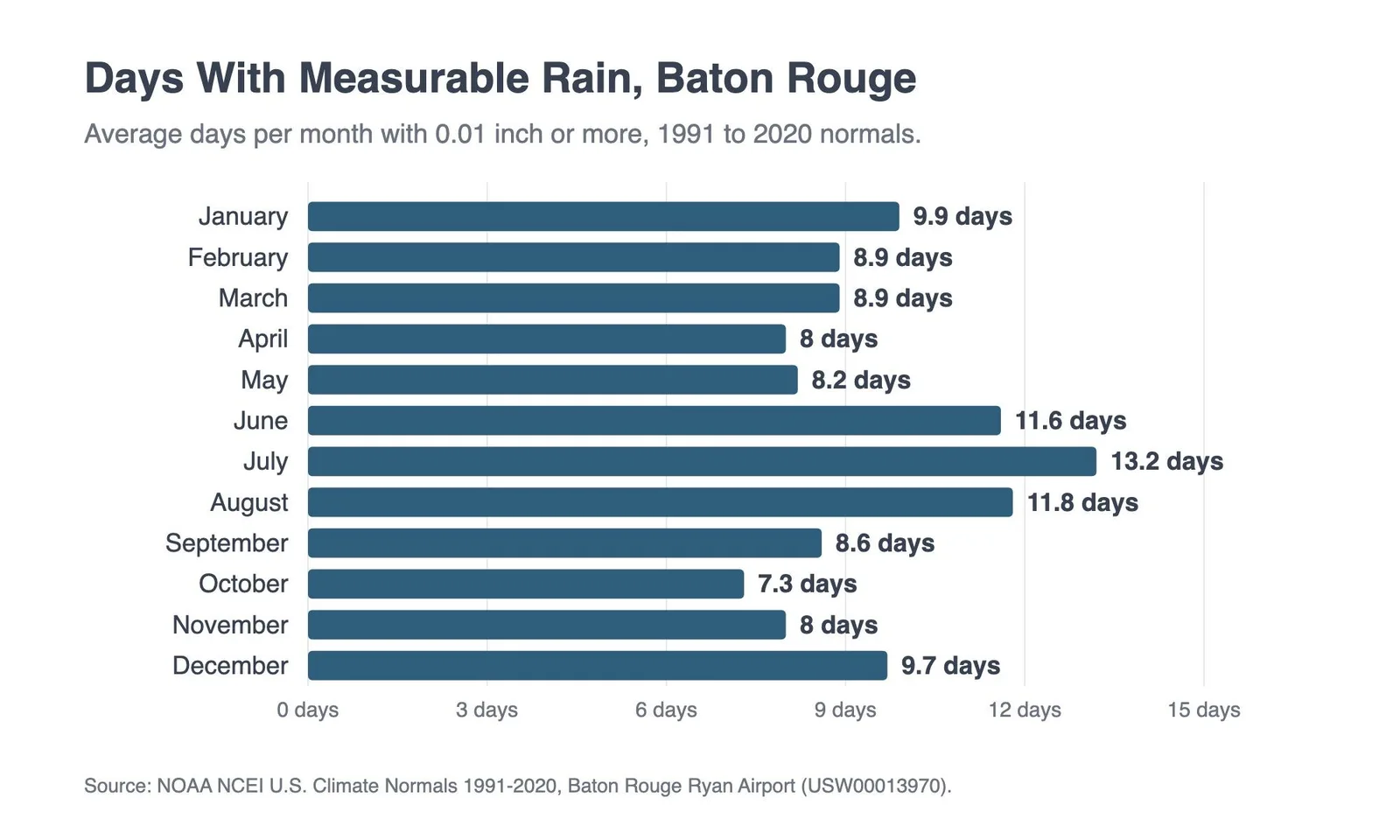
Average days with measurable rain by month, Baton Rouge, 1991 to 2020.
The wettest stretch lines up with the hottest. June, July, and August average 36.6 rain days combined, while average temperatures run near 81 to 83 degrees.
The coldest month, January, averages 52 degrees. That means no month’s average in Baton Rouge drops below the 35-degree line where the index stops counting.
Why Posts Face a Different Test
There is an important limit to the index. It was built for wood exposed above ground, such as pickets, rails, and trim, and the report says it is not meant to predict how long any specific structure will last.
A fence post is buried. The section below grade sits in contact with soil moisture, which is a harsher exposure than anything the index measures.
The American Wood Protection Association handles this with use categories, which appear on the end tags of treated lumber. Its standard places sawn fence posts in Use Category 4A, ground contact, while unpainted fence pickets fall under 3B, above ground. A heavier 4B category covers ground contact in severe settings, including “climates with a high potential for deterioration.”
Because the category is printed on the end tag or treatment stamp, it can be checked before a post goes in the ground.
What a Mississippi Post Test Found
The clearest evidence of what ground contact does to unprotected wood comes from a test plot just east of Louisiana. The Forest Products Laboratory set southern pine posts, 4 to 5 inches across, about one-third of their length into the soil at a site in southern Mississippi.
The site sits in what the researchers describe as a high decay and high termite hazard zone. According to the long-running fence post study in southern Mississippi, published in 2005 after 53 years of exposure, untreated southern pine posts lasted about 2 years.
Treated posts were a different story. Several of the oil-type preservatives in the test, including creosote and pentachlorophenol, produced posts with calculated life spans of more than 60 years.
Those were older industrial treatments on a research plot, not modern retail fence stock. The gap between 2 years and 60-plus years still shows how much the treatment of the buried section matters in a climate like this one.
Who Builds Fences in Livingston Parish
Homeowners in the Denham Springs area either set posts themselves or hire someone to do it.
Acadian Services is one company that describes fence installation in Denham Springs on its website. It lists wood privacy fence in cedar and treated pine, in board-on-board or standard picket styles, along with galvanized and black vinyl-coated chain link, vinyl, ornamental aluminum, and gates.
The company says its posts are set in concrete on a string line and allowed to cure before pickets go on. It also treats tear-out and haul-off of an old fence as part of the same job, and it works within about 50 miles of Denham Springs.
Questions Worth Asking Before a Fence Goes In
None of the federal data says a wood fence is a bad choice in South Louisiana. It says the buried part of the fence carries most of the risk, and that the details at ground level decide how long it lasts.
A few practical checks for any Livingston Parish fence project:
- Look for the use category on the end tag or stamp of every treated post.
- Ask what the posts will be set in and how long they cure before rails and pickets are hung.
- Ask what happens to the old fence and its posts if one is being replaced.
- Walk the line after a heavy rain and note where water stands near post locations.
- Plan for the summer months, when rain days and heat peak together.
The decay index has tracked these conditions for more than 50 years. By its measure, the Baton Rouge area has been one of the harder places in the country to keep wood sound, and the newest normals point the same way.