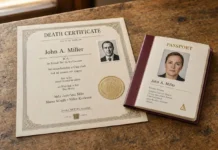
Yes, but only within the law, and the real process looks far less like disappearing and far more like rebuilding your documents, records, and life from the ground up.
WASHINGTON, DC. The fantasy is familiar. A person walks into trouble under one name and walks out with another. New passport. New city. Clean break. No trail. No questions.
Real life is much messier.
It is possible to create a new identity in a legal sense. People do it every year through court-approved name changes, corrected civil records, updated tax and social security documentation, new passports, relocation, and, in rare cases, government protection programs. But the idea that a person can simply erase the past and become untraceable is mostly fiction.
That distinction matters more than ever in 2026.
A lawful identity change is about documentation, continuity, and compliance. An unlawful one is about deception, forged records, false statements, or synthetic identities built to fool banks, borders, employers, or the state. The gap between those two worlds is where many people get confused, and where many get into serious trouble.
The question is not whether a new identity is possible. It is. The real question is what kind of identity change is legally available, what problem it actually solves, and what parts of a person’s old life can never fully disappear.
The movie version is fake, but the legal version is real
The cleanest way to understand this topic is to separate reinvention from impersonation.
Reinvention is legal when it follows the rules. A person may change a name, update civil records, revise licenses, obtain new travel documents, move jurisdictions, change how they present professionally, and reorganize financial life in a way that reflects new lawful records. In that sense, people can build a new legal identity.
Impersonation is something else entirely. That is when someone uses documents they were not entitled to, lies on government forms, invents a person who does not legally exist, or conceals material facts from banks, immigration officials, courts, or the state. That is not privacy planning. That is fraud.
The American bureaucracy itself makes the line surprisingly clear. The U.S. State Department’s own passport rules make plain that if your name changes, the passport can change too, but only when supported by certified legal documentation. That is the system in a nutshell. The state will recognize a lawful transition. It will not bless a fictional one.
This is why the first answer to the headline question is yes, but with a giant qualification attached. You can create a new legal identity. You cannot legally invent a false one.
Why people ask for this in the first place
Not everyone exploring this subject is trying to escape the law. In fact, many are trying to escape something else.
Domestic abuse survivors may need distance from an abuser. Victims of stalking or harassment may need a fresh start in a place where their prior address, name, and contact trail are not easily surfaced. Public figures and business owners caught in reputational crises may want a lawful restructuring of how they live and travel. Families facing extortion fears, politically exposed risk, or digital doxxing may want greater separation between their public profile and private life.
Others are thinking less dramatically. They are tired of being searchable. They want a quieter life, less data exposure, fewer linkages between old litigation, old media coverage, and present-day business activity. In a world where a decade-old article can follow someone into every new meeting, the desire to reset is no longer fringe.
That helps explain why specialists in this field have attracted attention. Firms like Amicus International Consulting frame the issue not as fantasy or evasion, but as a structured legal problem involving documentation, jurisdiction, travel, privacy, and risk management. Whether one agrees with every claim in that market or not, the demand itself is real and growing.
A new name is often the easy part
The romantic version of identity change focuses on the name. The practical version focuses on everything that comes after.
Changing a name through a court order, marriage, divorce, naturalization record, or equivalent legal mechanism is often just step one. Once the name changes, the record ecosystem has to catch up. That means passport files, social security records, tax records, banking files, employment records, property titles, insurance, professional licenses, school records, immigration documents, utilities, medical systems, and digital accounts.
This is where many people realize that a legal identity is not one document. It is an interlocking stack.
If even part of that stack is neglected, the result is confusion rather than privacy. A traveler whose passport, tax profile, bank onboarding file, and employment history tell slightly different stories is not living under a clean new identity. That traveler is creating friction. Friction leads to questions. Questions lead to scrutiny.
In other words, the true work is not getting a new name. It is building a coherent administrative life around that name.
The past rarely disappears; it gets cross-referenced
That is the hardest truth in this space, and the least marketable one.
A legal identity change does not usually vaporize the old identity. Courts maintain records. Agencies maintain historical ties. Financial institutions have retention duties. Immigration systems often preserve prior names, aliases, or linked records. School transcripts do not always vanish. Property records are searchable. Litigation databases persist. Corporate filings can live for years. Tax systems are designed for continuity, not amnesia.
For many people, that is disappointing. They do not want continuity. They want rupture.
But rupture is exactly what institutions are trained to distrust.
The modern compliance state likes chains of explanation. Why did the name change? What documents support it? How do the old and new records reconcile? Is the customer still the same beneficial owner, taxpayer, or account holder? When the answers are orderly, life moves on. When they are not, alarms go off.
That is why the most realistic version of a new identity is not disappearance. It is a controlled transition.
Biometrics have changed the game
Even that controlled transition has become harder to fake in the last decade, because governments and border systems now lean far more heavily on the body itself.
Faces, fingerprints, travel history, and linked entry exit records make the old mythology of starting from zero much less plausible. A person may have updated civil records, but the broader travel and security environment increasingly depends on biometric matching and historical data.
That is not theoretical. Recent Reuters reporting on the expansion of facial recognition at U.S. borders captured the direction clearly. The trend line is toward more biometric verification, not less. Across advanced border systems, identity is less about what a paper document says in isolation and more about whether the paper lines up with databases, prior movements, and a face in front of the camera.
For lawful applicants, that means documentation has to be cleaner than ever. For unlawful ones, it means the room for improvisation keeps shrinking.
This is one reason the topic has shifted from cloak-and-dagger fantasy to compliance engineering. The body now travels with the data.
What legal identity change can actually accomplish
Still, it would be wrong to say a new identity has no practical value. In many situations, it can be deeply meaningful.
It can reduce casual discoverability. It can weaken the connection between an old online footprint and current daily life. It can help a harassment victim rent housing, seek work, register utilities, or enroll children under an updated legal identity. It can support relocation planning. It can change how travel documents appear. It can create emotional and physical distance from a damaging chapter.
For some, that is more than enough.
The problem is that many people do not really want privacy. They want total severance. And total severance is rarely available outside extraordinary state action, such as narrow protection programs or extremely unusual national security circumstances.
Most civilians are not receiving a brand new existence from the government. They are receiving a lawful record change that must be explained, documented, and lived consistently.
That may sound less cinematic, but it is often still powerful. A person does not always need invisibility. Sometimes they just need enough legal distance to live safely and function normally.
Where people cross the line
This is also where the conversation gets dangerous online.
Search results are full of reckless promises. Buy a new identity. Get a clean passport in days. Create a backstory that cannot be traced. Open accounts under a new profile. Evade watchlists. Escape your old life completely.
Those claims tend to collapse into one of three categories.
The first is outright fraud. Fake documents, forged breeder records, false applications, or stolen identities dressed up as solutions.
The second is synthetic identity construction, where real and invented data are blended to fool private institutions. That may look clever on the internet. In reality, it is exactly the kind of conduct that fraud teams and prosecutors increasingly target.
The third is marketing that borrows the language of legality while obscuring the gaps between a court-approved name change and a fully functional, internationally consistent identity profile.
That is why anyone considering this path needs to ask one unglamorous question before all others: who will recognize the new identity, on what legal basis, and with what supporting records?
If the answer is vague, that is the answer.
The digital footprint problem
There is another obstacle that older discussions of this topic often ignore. Even when government documents are updated lawfully, the internet keeps score.
Archived webpages, data brokers, old social posts, cached directories, corporate bios, local news articles, podcast interviews, event pages, court search tools, fundraising campaigns, leaked databases, genealogy sites, and people finder services can all keep old names alive long after a legal transition.
This means that a new identity in 2026 is not just a document project. It is also a data hygiene project.
People seeking a real reset often discover that the toughest part is not the courthouse. It is the search engine. It is the old PDF. It is the forgotten licensing directory. It is the metadata trail that no one remembers creating until it starts surfacing in the wrong context.
A lawful identity restructuring, then, increasingly has three layers. Government documents. Private institutional records. Public data exposure.
Ignore any one of them, and the transition stays incomplete.
Why the market for Plan B identities has grown
This is where the broader cultural shift comes in.
More affluent clients now think in terms of redundancy. A second residence. A second citizenship. A second banking jurisdiction. A second place to land if politics, security, or reputational conditions worsen. The same mindset is now shaping identity planning.
Not everyone who asks about a new identity wants to disappear. Many simply want options. A quieter profile. More control over family exposure. Better separation between public controversy and private life. Documents that match a rebuilt personal reality. A lawful Plan B.
That may be why this topic keeps resurfacing even as enforcement technologies improve. The tools of surveillance have become stronger, but so has the pressure people feel from transparency, searchability, and permanent digital memory.
The result is a strange modern paradox. It is harder than ever to fake an identity, but easier than ever to understand why someone might want a lawful new one.
So, is it possible?
Yes.
But only if the goal is lawful transformation, not magical disappearance.
A new identity is possible when it grows out of real legal acts, real records, and real continuity. It is possible when the paperwork is coherent, the explanations are truthful, and the new life is built carefully across agencies, banks, employers, borders, and digital systems.
No, if the goal is to erase every trace of the old self.
No, if the plan depends on false documents, fake stories, synthetic data, or concealment from institutions that are legally entitled to know who you are.
And no, if what someone really wants is not privacy or safety, but immunity from consequences.
That is the mature answer to a question that is usually asked in immature terms.
The real story is not that people can become nobody. It is that, under the right legal conditions, they can become somebody else in an official sense, and then do the slow, demanding work of making the rest of life line up behind that fact.
In 2026, that is what a new identity actually means. Not disappearance. Documentation. Not fantasy. Administration. Not escape from reality, but a negotiated way to live inside it under a different, lawful name.