State law leaves little room once a properly notified defendant fails to appear, and federal data shows how often the problem comes up.
A court date can be missed for ordinary reasons. A shift may not be moved, a notice may go to an old address, or someone may misread the calendar. The reason may matter later, but in Louisiana it does not stop the first step.
Article 333 of the Louisiana Code of Criminal Procedure says that when a properly noticed defendant fails to appear, the court shall immediately issue a warrant for arrest. The word is shall, not may. For anyone on bail, and for the families who helped arrange it, that makes a calendar mistake a more serious event than it first appears.
What the statute sets in motion
Article 333 lays out a sequence. The court issues the warrant on its own motion or on the prosecutor’s motion. The clerk of court then notifies the prosecutor of the warrant. The defendant and any personal surety also receive notice by U.S. mail or electronic means.
Those notices go to the addresses on file under Article 329. That detail has practical weight. A person who has moved and not updated the court may not see the notice at all, even though the warrant is active.
The statute also sets a clock for the bail industry. The bail agent and the commercial surety must receive notice within 60 days of the failure to appear, either electronically or by certified mail with a return receipt. If that notice is not sent within 60 days, the article releases the surety from its obligations on the bail undertaking. The legislature’s history for the article lists an amendment as recent as 2026, so older summaries may not match the current text.
When missing court becomes its own charge
A warrant is not the only possible result. Louisiana also has a separate crime called jumping bail, found in R.S. 14:110.1. The statute defines it as the intentional failure to appear at the date, time, and place ordered by the court.
Intent is the key word, but the law helps prosecutors with it. Once the state proves that notice was given under the relevant articles, a rebuttable presumption of notice applies, and the burden moves to the defendant to show that notice was not received.
The maximum penalties depend on the original case. When the bail secured a misdemeanor, the statute allows up to six months in jail, a fine of up to $500, or both. When it secured a felony, the statute allows up to two years at hard labor. Those are ceilings written into the law, not a forecast of what happens in a given case.
What the national numbers show
Louisiana-specific figures were not part of the federal data reviewed here, so the national numbers need to be read as context. The most detailed federal source is older but still useful. The Bureau of Justice Statistics report Felony Defendants in Large Urban Counties, 2009 tracked felony defendants in the 75 largest counties for up to a year.
It found that 17% of released defendants missed a scheduled court appearance and had a bench warrant issued. That was about the same as in 2006, and lower than the 24% rate BJS reported for the years before 1996.
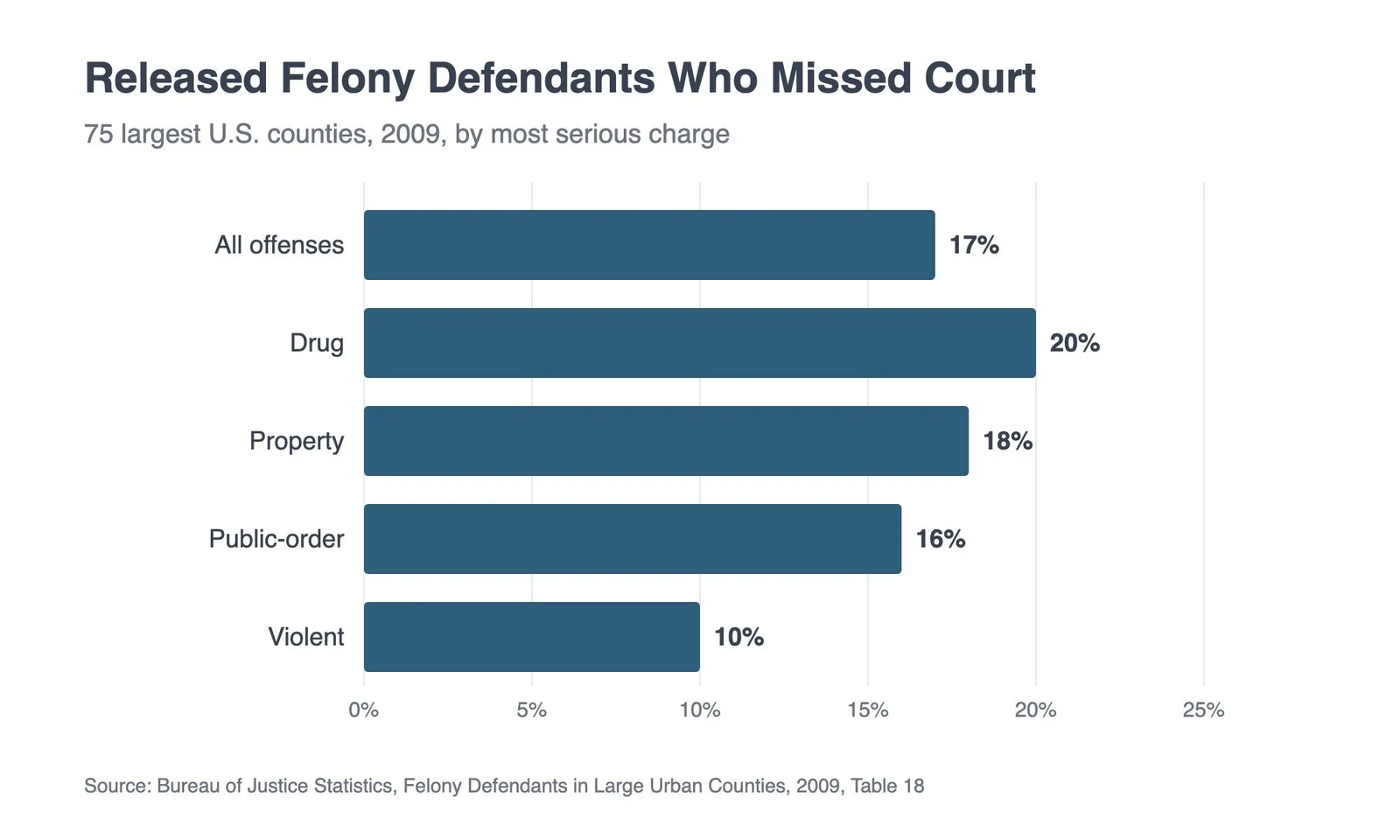
Source: Bureau of Justice Statistics, Felony Defendants in Large Urban Counties, 2009, Table 18.
Most of those cases did not end with a person on the run. In the same table, 13% of released defendants missed court and were later returned to court during the one-year study period, while 3% remained fugitives. The rates also varied by charge, from 10% for violent offenses to 20% for drug offenses.
These figures carry clear limits. They cover felony cases only, in large counties, and they are from 2009. They do not describe misdemeanor dockets or smaller parish courts, and they cannot explain why any individual missed a date.
Why bail companies pay close attention
The same report shows how central commercial bail was to pretrial release in those counties. Private surety bonds accounted for 49% of all releases in 2009, which made them the most common method. Release on recognizance came next at 23%.
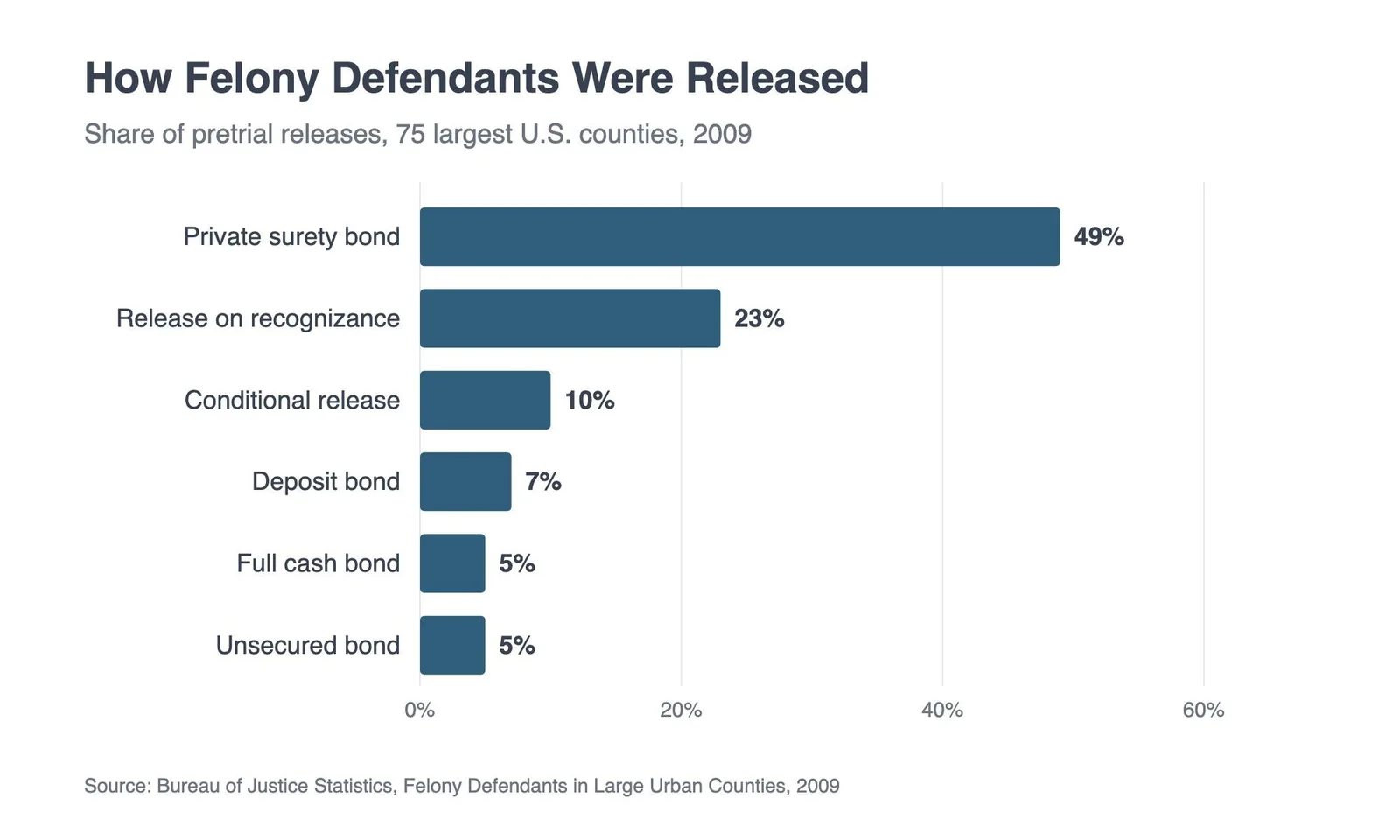
Source: Bureau of Justice Statistics, Felony Defendants in Large Urban Counties, 2009. Other release types not shown.
That helps explain why a missed date ripples outward. A surety bond ties a private company to a person’s court appearance, and can also tie a family member or friend who arranged the bond. Their obligations depend on the terms they signed, which is one reason to read that paperwork before a problem arises.
The stakes sit inside a larger picture of jail populations. The BJS report Jail Inmates in 2023 found that 70% of people held in local jails at midyear 2023, or 467,600 people, were unconvicted. In other words, most people in jail on a given day have a case still working through the courts or are being held for other reasons.
What people with an open warrant can do
The first practical step is to confirm the facts with an official source. The clerk of court in the parish where the case was filed keeps the record, and a lawyer or public defender can check it as well. Commercial warrant search websites are not court records and may be out of date.
From there, no single form makes a warrant disappear. Clearing one generally means returning to the court that issued it, and a lawyer can advise on asking the court to recall the warrant. Anyone in that position should keep proof of why the date was missed, such as a work schedule, a medical record, or the notice itself, and share it with counsel. Keeping a current address on file with the court helps prevent a repeat.
Bail may also come up again. Some Louisiana bail companies write bonds for these situations, and QRF Bail Bonds, a company that sells them, describes its process for warrant and failure-to-appear bonds in Louisiana. Terms and outcomes vary by court and by case, and a bond does not resolve the underlying charge.
A rule built for certainty, with questions left open
Article 333 is written to remove doubt about what a court does next. It says less about the everyday causes of a missed date, such as an outdated address, an inflexible job, or a misunderstood notice. Those causes sit outside the statute, but they shape who ends up with a warrant.
The national data on this question is now well over a decade old, and it covers felonies in large counties. More recent, parish-level reporting on missed court dates would give Louisiana courts, families, and bail companies a clearer view of how often this happens and which notice methods reach people in time.