


|
What this covers
|
A folding desk is described by a set of numbers that look complete and are not. Width, depth, height, sometimes a weight. Those describe the desk in use. They say almost nothing about whether it will work in a small apartment, because in a small apartment the question is what the desk does when it is not a desk.
Four measurements decide that, and only two of them are reliably published.
One: Open Footprint
The familiar one. Width and depth of the desktop when the desk is set up.
It is the number most listings lead with and the least decisive, because every desk in the category has roughly the dimensions a laptop and a monitor require. The variation between products here is small. The variation in the other three numbers is enormous.
Two: Clearance Footprint
The open footprint plus the space a person needs to use it.
A desk 24 inches deep does not occupy 24 inches of a room. It occupies 24 inches plus the depth of whoever is sitting at it, plus enough room behind them to get in and out. For a seated user with a chair, that is commonly another 30 to 36 inches. For a floor-level working position, it is considerably less, because there is no chair and no chair-pushback.
This is the number that decides whether a room still works with the desk in it, and it almost never appears in a product listing. It has to be calculated.
|
Setup |
Desk depth |
User and access |
Total depth consumed |
|
Desk and office chair |
24 in |
~34 in |
~58 in |
|
Desk and dining chair |
24 in |
~30 in |
~54 in |
|
Standing at desk |
24 in |
~24 in |
~48 in |
|
Floor-level working position |
20 in |
~20 in |
~40 in |
The gap between the top row and the bottom row is more than a foot and a half of floor depth, which in a studio apartment is the difference between a room that works and a room that does not.
Three: Folded Depth
The one that actually decides storage, and the one most often missing.
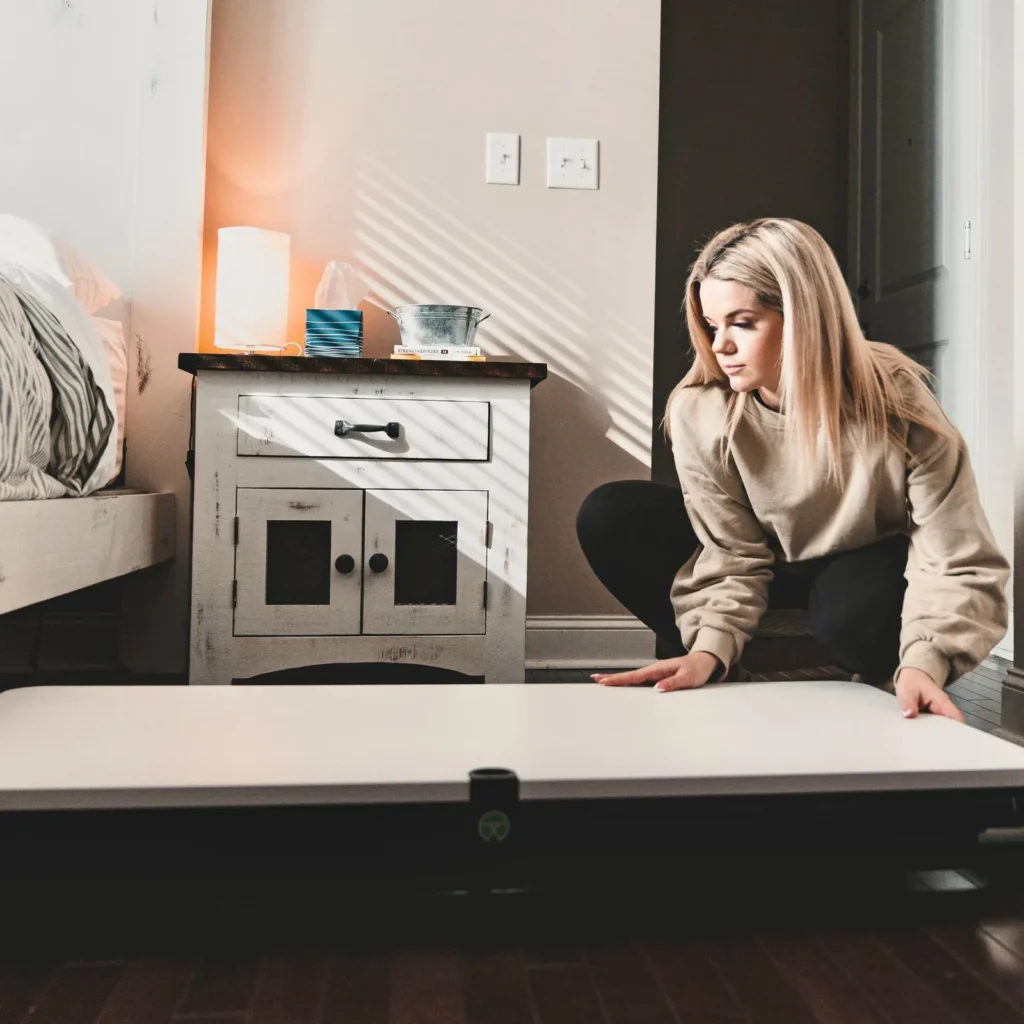
When a folding desk is closed, its depth is what determines where it can live. Under a bed, behind a door, in a closet, in the gap beside a sofa. Each of those is a depth constraint, not a width or height constraint.
A desk that folds to four inches slides into places a desk that folds to nine inches cannot. Both might be described as folding, and the listing for both might emphasize the same open dimensions.
Useful reference depths, worth measuring in an actual apartment rather than assuming:
- Behind a standard interior door when open: often around 4 to 5 inches of usable gap
- Under a platform bed: varies hugely, from nothing to over a foot
- Beside a sofa against a wall: usually 3 to 6 inches
- Inside a closet, in front of hanging clothes: often 8 to 12 inches
If a folded depth is not published, it is worth asking for before ordering. It is the single most predictive number for whether the desk gets stored or stays up permanently, and a desk that stays up permanently is not a folding desk in any meaningful sense.
Four: Swept Area
The space the mechanism needs while it is moving.
A desk that folds downward against a wall sweeps an arc as the top comes down. A desk with legs that fold under needs room to tip or lift. A desk on a hinge needs clearance on the hinge side that is not required in either the open or the closed state.
Swept area catches people out because it is invisible in both end states. The desk fits open. The desk fits closed. The desk cannot be converted between the two because a bed is in the arc.
Why Stored Orientation Changes the Answer
A desk stored flat against a wall is limited by its folded depth. The same desk stored upright is limited by its height, and its folded depth stops mattering.
That sounds obvious and it changes which product is correct. A wide desktop that stores vertically may be easier to accommodate than a narrower one that only stores flat, because a vertical store uses wall rather than floor. In apartments, wall is the cheaper resource.
Before comparing products, it is worth deciding where the desk is going to live when closed, because that decision determines which of the four numbers is the binding constraint. Roundups that compare on open dimensions alone are comparing the least decisive measurement, which is why Lillipad, which builds for this end of the market, leads its comparison of foldable desks built for small apartments is more useful when it covers folded size and storage behavior rather than desktop area.
The Order to Measure In
Working from the room backward rather than from the product forward.
- Pick the storage location first. Measure its depth, width and height.
- Pick the working location. Measure the available depth including user clearance.
- Check the path between them. A desk that is stored in a bedroom and used in a living room has to travel through a door frame.
- Only then compare products, filtering on folded dimensions before open ones.
Most people do this in reverse, choose a desk on its open specification, and discover the storage problem after delivery.
How the Four Numbers Interact
They are not independent, and the trade-offs between them are what distinguish one design from another.
A desk that folds very flat usually achieves it by having a thin desktop, which costs rigidity. A desk with a generous open footprint has more material to store, so its folded depth rises. A mechanism that needs no swept area, because it lifts straight up rather than rotating, tends to be heavier and more complex.
|
If a design optimizes |
It usually gives up |
|
Minimum folded depth |
Desktop thickness, and therefore stiffness |
|
Maximum open footprint |
Folded size and weight |
|
Zero swept area |
Mechanism simplicity and weight |
|
Lowest weight |
Load capacity and perceived solidity |
|
Fastest setup |
Folded compactness, because fewer joints means bulkier folds |
There is no design that wins every row, which is why the correct product depends entirely on which constraint is binding in a particular apartment. Somebody storing a desk behind a door needs the first row and can tolerate a thinner top. Somebody carrying it between rooms daily needs the fourth and should accept a smaller working surface.
Working out which row matters most is the actual decision. Everything after that is comparison shopping.
Two Numbers That Are Not Dimensions
Two further things decide usability in a small apartment and neither is a measurement.
Weight. A folding desk that is moved daily is handled daily. A desk heavy enough to be awkward will stop being folded within two weeks, regardless of how small it folds.
Setup time. The same logic as weight. A conversion that takes a minute happens twice a day. A conversion that takes five minutes happens once and then stops happening.
Both of these convert a folding desk back into a fixed desk, which is the failure mode the whole category exists to avoid.
A tape measure and ten minutes beats every specification table, because the tape measures the gap the desk actually has to fit into rather than the desk somebody hopes it is.
Where Published Numbers Go Wrong
Three recurring problems with the figures that do appear on listings, all worth knowing before trusting them.
Rounded dimensions. A desk listed at 24 inches deep may be 24.4, and in a 24.5-inch gap that matters. Where a measurement sits close to a constraint, ask for the exact figure rather than the marketing one.
Dimensions excluding protrusions. A stated depth sometimes covers the desktop and not a cable tray, a latch, a handle or a bracket projecting beyond it. Those are what catch on a door frame.
Folded dimensions quoted at the thinnest point. A desk that tapers can be described by its slimmest section while the hinge end is twice that. For storage in a tight gap the relevant number is the thickest point, not the average.
|
Published number |
What to confirm |
|
Open depth |
Whether it includes any rear protrusion |
|
Folded depth |
Whether it is measured at the thickest point |
|
Width |
Whether handles or latches extend beyond it |
|
Weight |
Whether it is the desk or the shipped package |
None of this is deception. It is the ordinary imprecision of product copy, and it stops being harmless the moment a measurement sits within an inch of a constraint.
The Summary
Open dimensions tell you whether a laptop fits on it. Folded depth, clearance footprint and swept area tell you whether the desk works in the apartment.
Three of those four are usually absent from the listing and all three are measurable in ten minutes with a tape measure, before anything is ordered.